
Jungfraujoch – Top of Europe: The Complete Guide to Visiting
In this guide, we share our opinion on visiting Jungfraujoch: is it a tourist trap or an unforgettable experience?
If you’ve searched for things to do in Switzerland, you’ve probably come across those images advertising the train journey to Jungfraujoch. The highest railway station in Europe, at 3,454 meters above sea level, surrounded by huge glaciers, panoramic viewpoints and the famous Top of Europe sign. But is Jungfraujoch really worth visiting? Is it as spectacular as people say, or is it just another overpriced attraction backed by a lot of marketing?
In this guide, we tell you everything you need to know to visit Jungfraujoch independently: what to see, how to get there, how much it costs, whether we think it’s worth it, and how to make the most of your day. We’ll also give you a few ideas for combining it with hikes and other places nearby, so you can get as much as possible out of your time in the Bernese Oberland.
Jungfraujoch at a glance: the railway station sits at 3,454 m above sea level. To enjoy the visit without rushing, we recommend allowing at least 4–6 hours, going up as early as possible and checking the weather forecast before buying your ticket. Between May 1 and October 31, 2026, seat reservations are mandatory. Our opinion: yes, it is worth it, especially if you love the mountains and can choose a day with good visibility.
What is Jungfraujoch – Top of Europe?
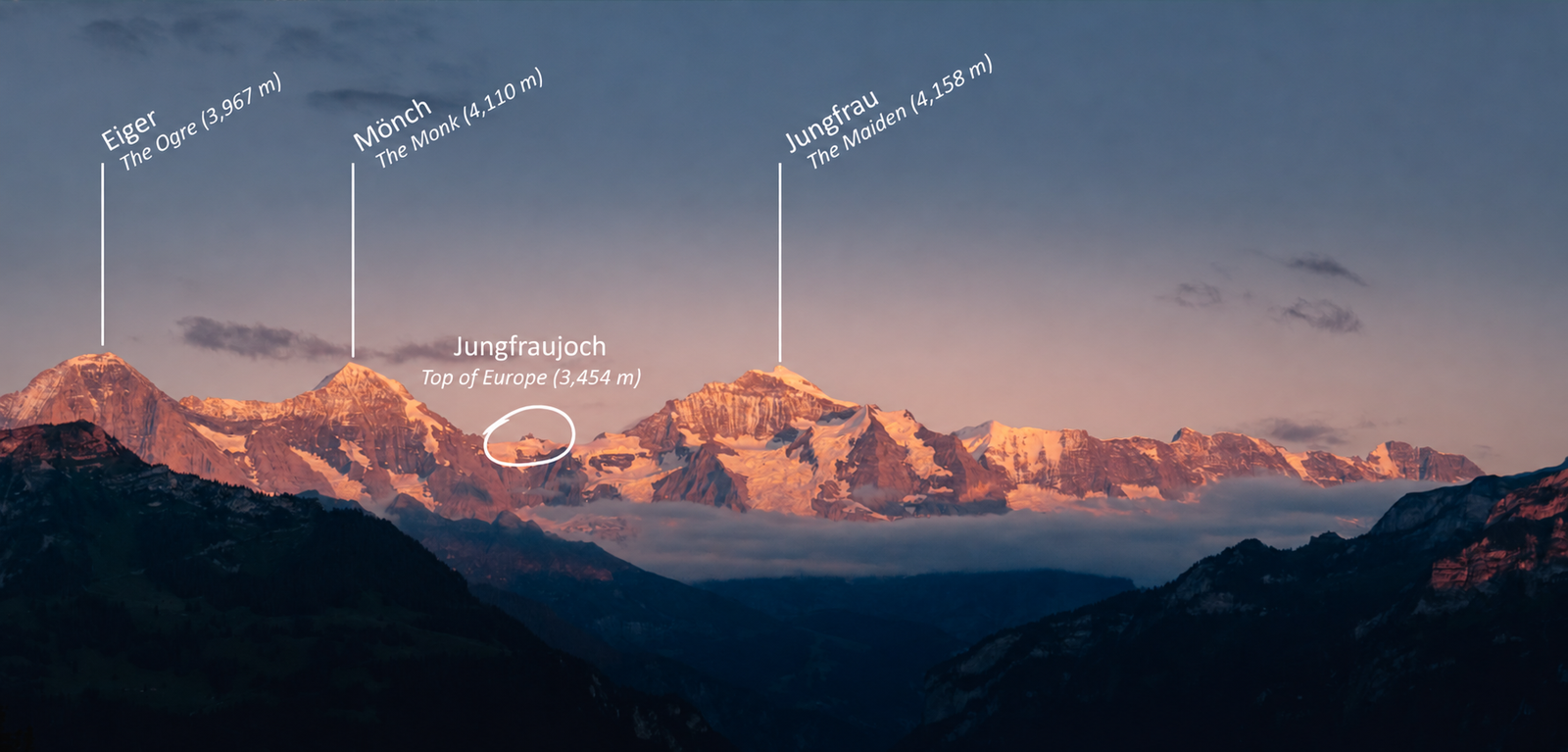
Jungfraujoch is a mountain saddle between the Mönch and Jungfrau, two of the best-known mountains in the Bernese Alps. Next to them stands the Eiger, forming the famous Eiger, Mönch and Jungfrau trio that has fascinated mountaineers and travelers for generations. Their names are commonly translated as the Ogre, the Monk and the Maiden. On the other side of Jungfraujoch lies the Aletsch Glacier, the longest glacier in the Alps.
Jungfraujoch is known as the Top of Europe because it is home to the highest railway station on the continent, at 3,454 m. This engineering achievement opened in 1912, after more than 7 km of tunnels were excavated through the Eiger and Mönch in extreme conditions over a period of more than 16 years. Thanks to the railway, people without mountaineering experience can access a true high-alpine environment without needing technical equipment to visit the main facilities.
In our opinion, visiting Jungfraujoch is much more than simply taking a train to a very high railway station. Below, we’ll explain what to see at Jungfraujoch and how to get the most out of your day, so you can decide for yourself whether it’s worth it.
Things to Do at Jungfraujoch: Top of Europe
Sphinx Observatory Viewpoint – 360° Views
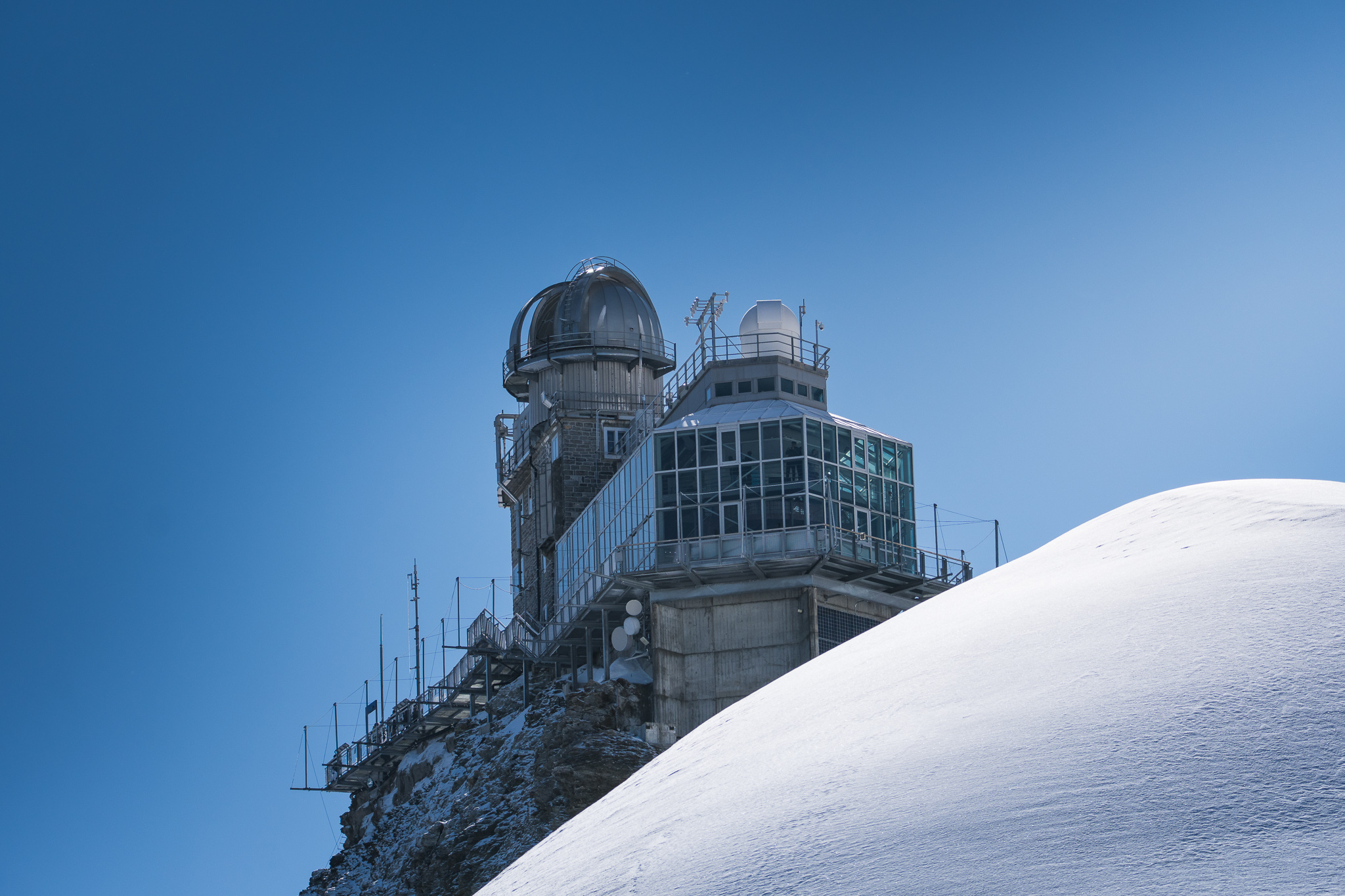
The viewpoint at the Sphinx Observatory is, without a doubt, the most spectacular of all the viewpoints you’ll find at Jungfraujoch (Top of Europe). It is also the highest point you can access during the visit, at 3,571 meters above sea level.
Its outdoor platform offers incredible panoramic views in every direction.
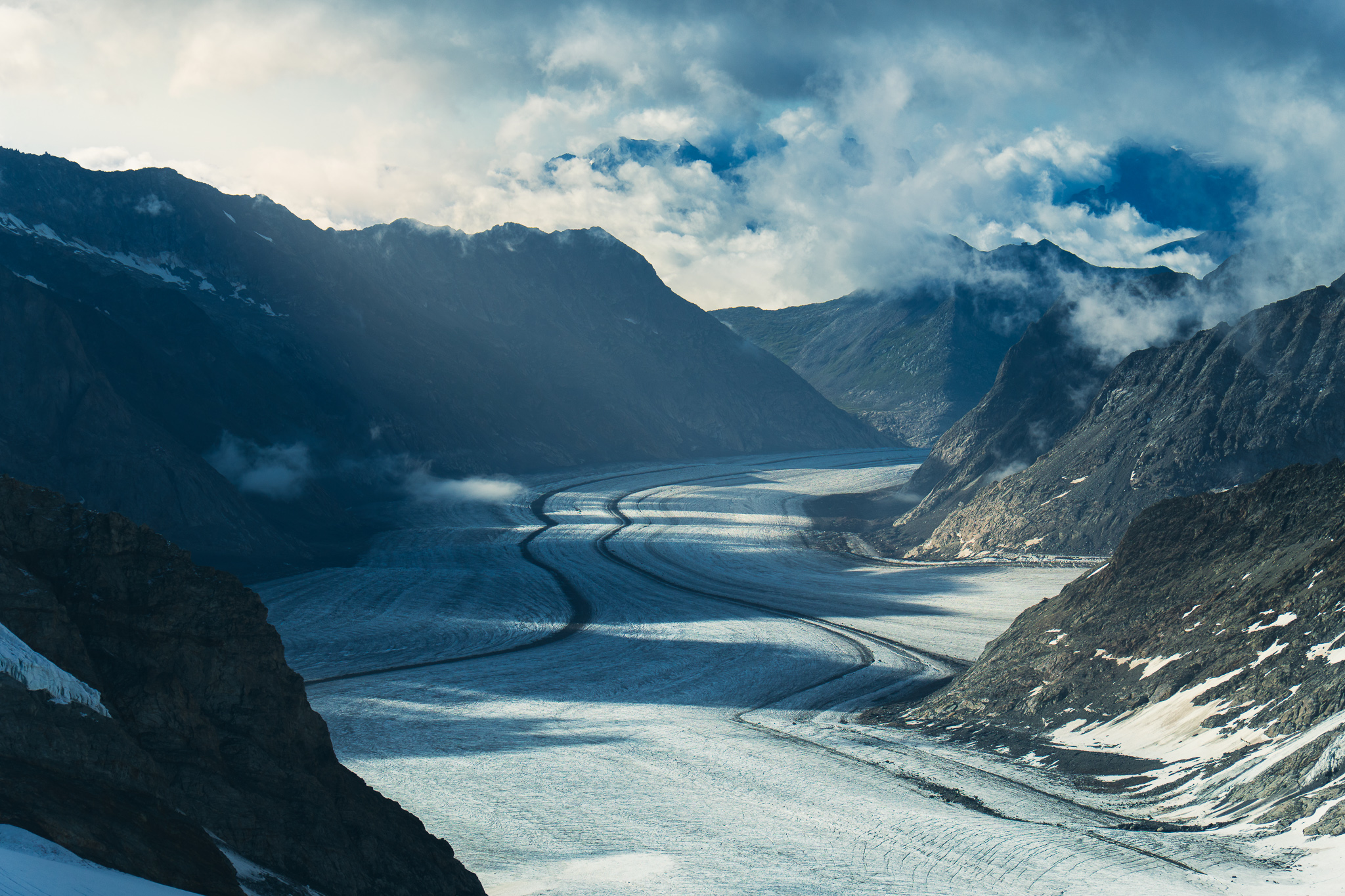
It feels like a real privilege to stand this high and look out across the surrounding Alpine peaks. On clear days with good visibility, the panorama can extend as far as the Black Forest in Germany and the Vosges in France.
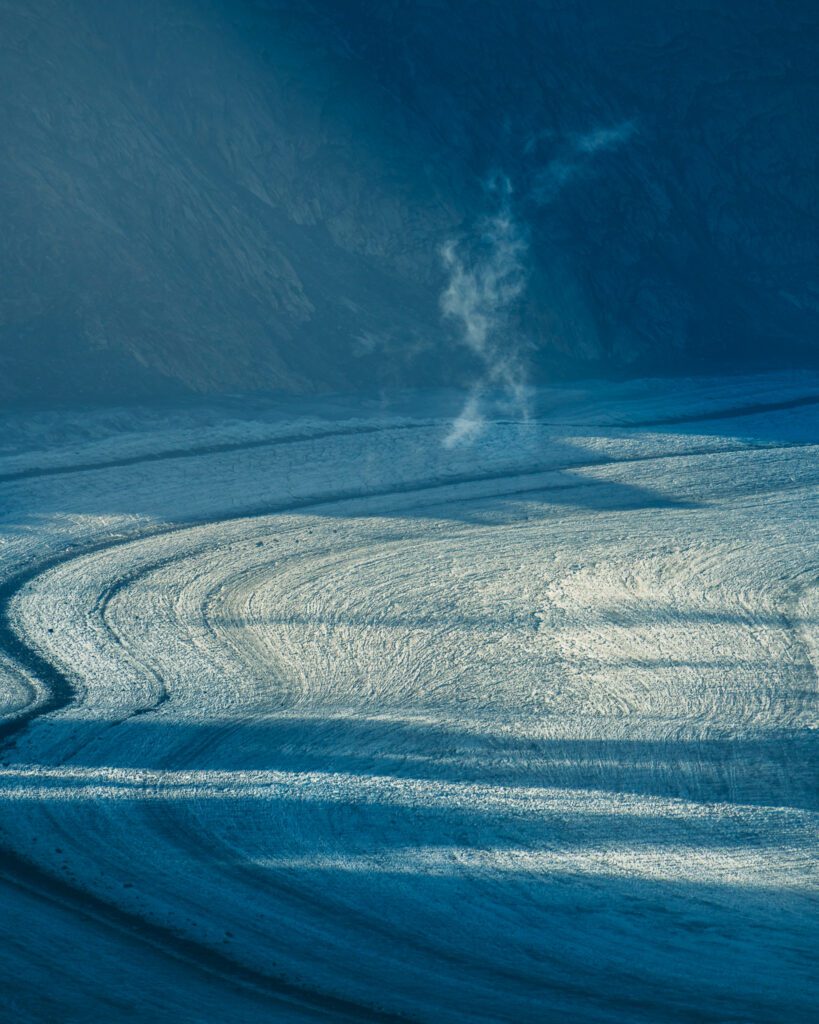
Glacier Plateau Viewpoint
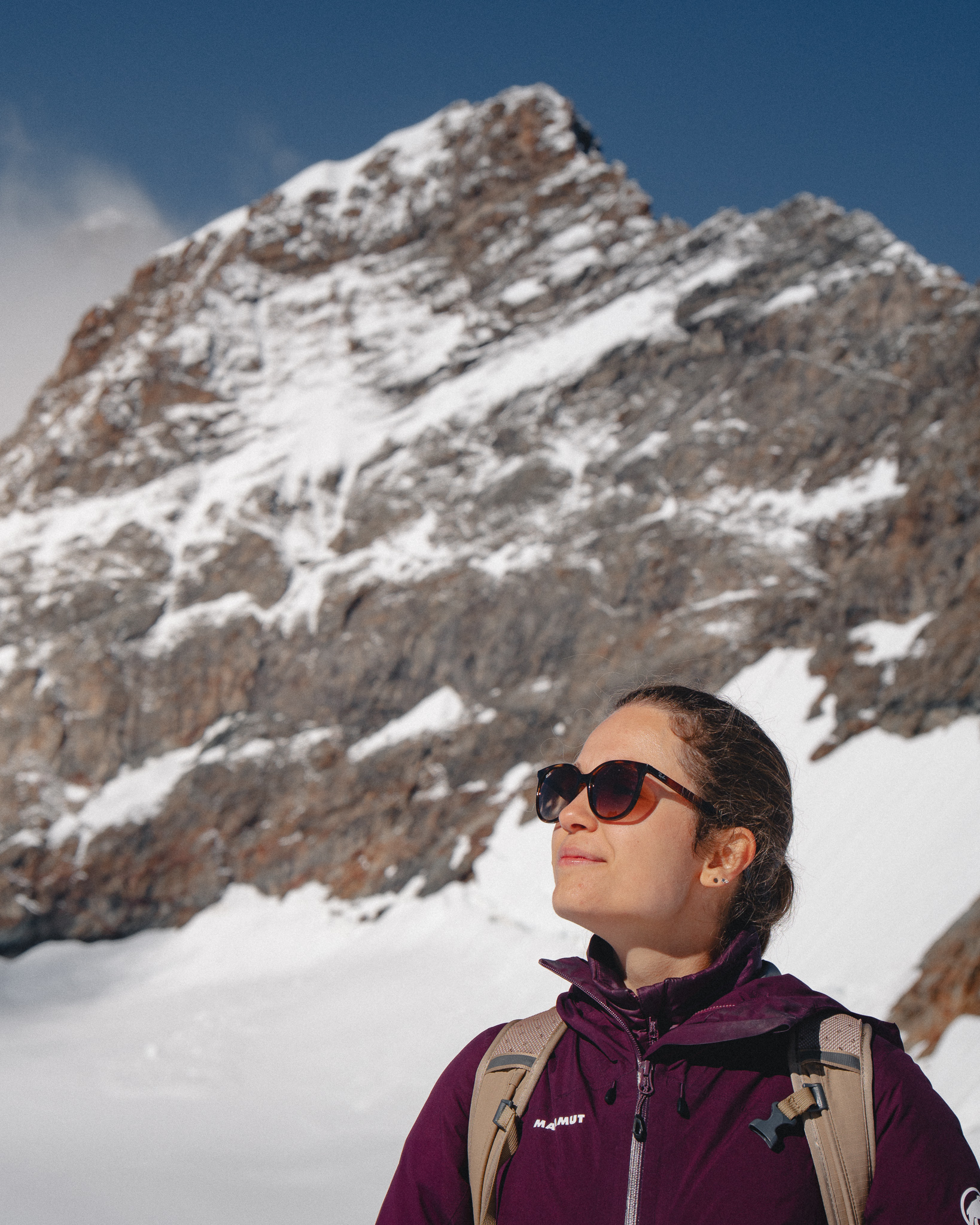
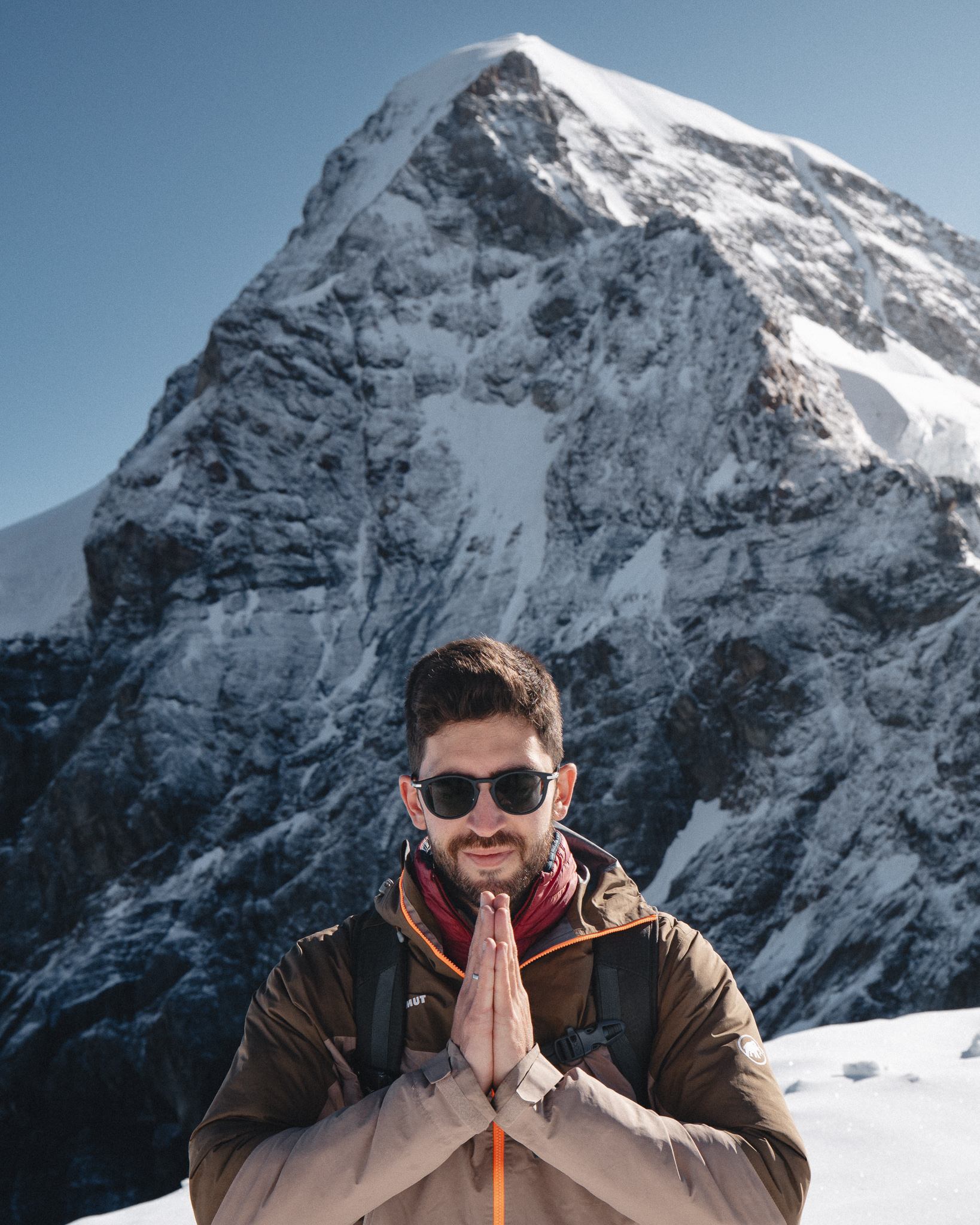
This is the second outdoor viewpoint you’ll find when visiting Jungfraujoch. It is a small, relatively flat area that sits lower than the Sphinx Observatory, so you get a much closer sense of the two 4,000-meter peaks beside you: the Jungfrau and the Mönch. From here you also get spectacular views toward the Aletsch Glacier and the UNESCO-listed Swiss Alps Jungfrau-Aletsch area, as well as toward Kleine Scheidegg and the Interlaken region.
To reach this viewpoint, follow the circuit signposted as the “Discovery Tour.” It is basically a tunnel connecting the railway station with the viewpoint, and along the way it includes two indoor attractions: Alpine Sensation and the Ice Palace, which we’ll explain in more detail below.
We took the first train of the morning, so there were quite a few low clouds covering some of the valley views. Even so, being able to stand this close to such incredibly high peaks was an amazing experience.
By the way, there is a Swiss flag in the middle of the plateau that is extremely popular for photos. As the day goes on and more trains arrive, people tend to queue here for their picture. If the photo isn’t particularly important to you, we’d recommend skipping the line and continuing with the visit so you can enjoy the views with fewer crowds. The queue is for the flag, not for the viewpoint itself.
Alpine Sensation
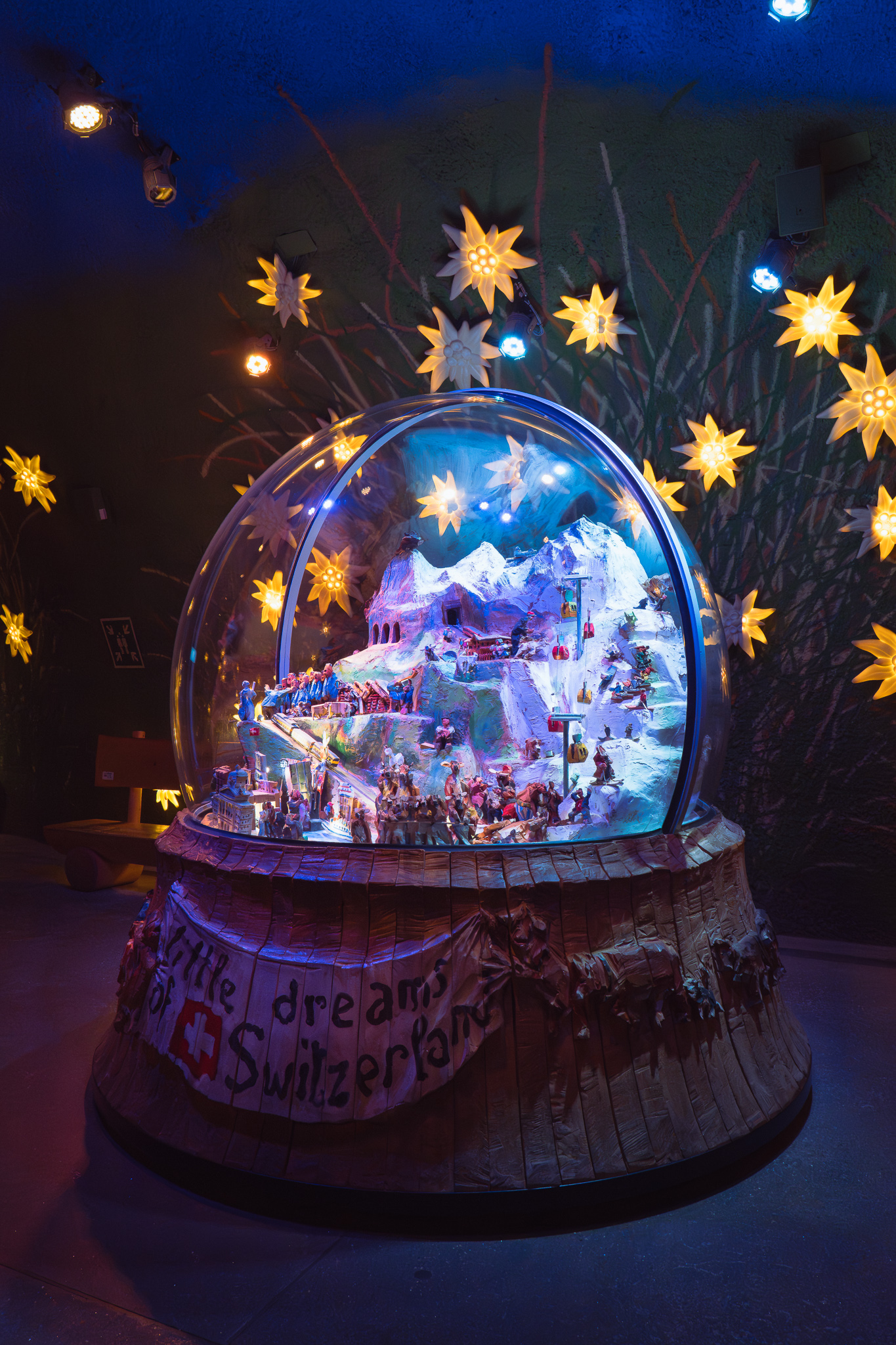
Alpine Sensation is one of the two main indoor attractions you’ll find at Jungfraujoch. It is inside the tunnel connecting the railway station with the Glacier Plateau and is designed as a multimedia experience.
Along the route, there are several areas with different lighting effects and even a 360° cinema showing a short film of Jungfraujoch through the four seasons.
There is also an area dedicated to the history of the railway, explaining how the idea was developed, the technical challenges involved and the people who worked on the project. In the same section, there is a more moving memorial to those who lost their lives during the construction of the tunnel.
It doesn’t take long to visit, but we think it is worth doing because it helps you understand the place you’re standing in a little better.
Ice Palace: Ice Sculpture Tunnels
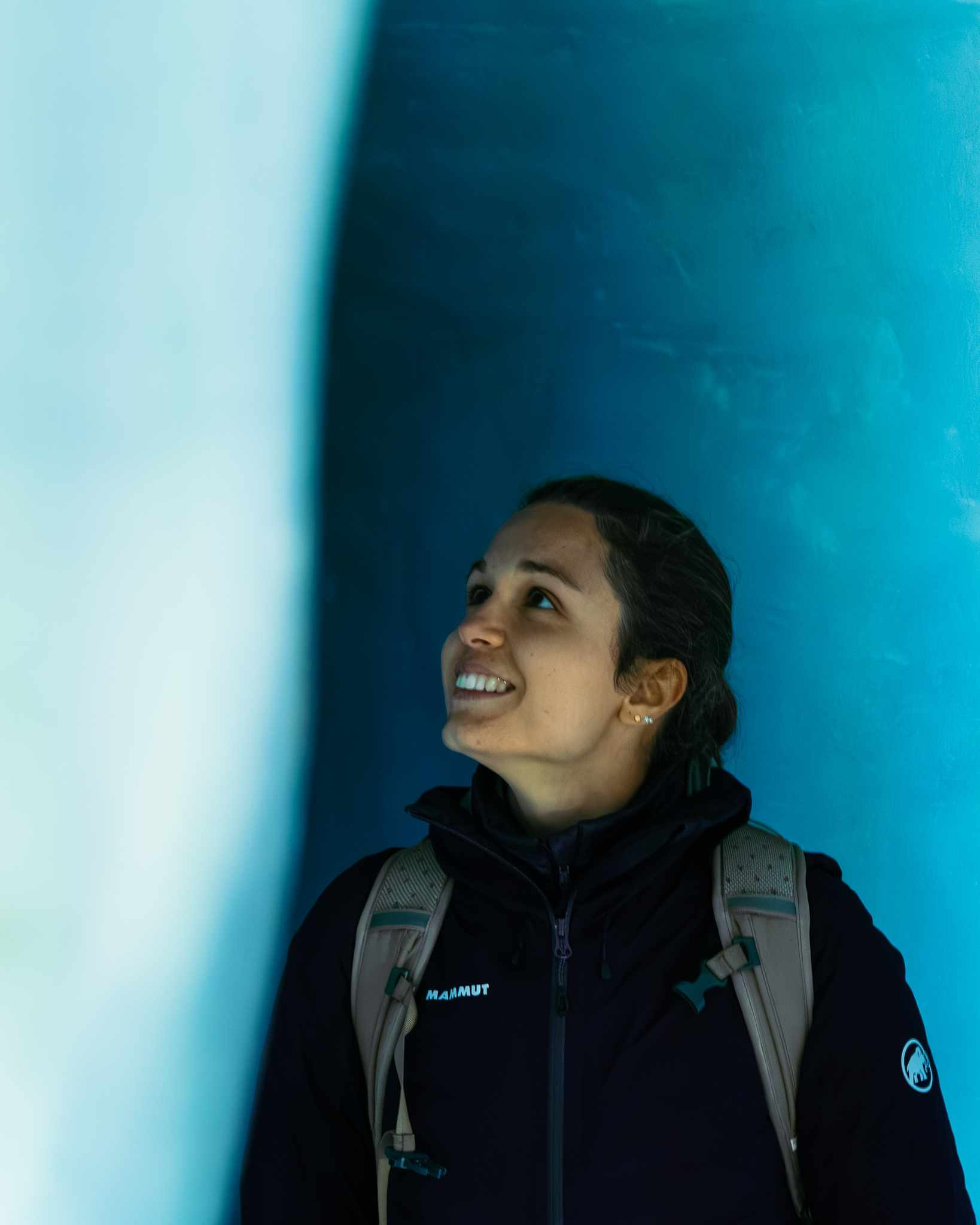
The Ice Palace is the second indoor attraction you’ll encounter at Jungfraujoch. It is also located inside the tunnel connecting the railway station and restaurant area with the Glacier Plateau viewpoint.
The name gives you a pretty good idea of what to expect: a series of tunnels carved into the ice. Along the way you’ll find a collection of ice sculptures, from animals to more abstract shapes, which makes the walk surprisingly fun, especially if you visit early when it isn’t too crowded.
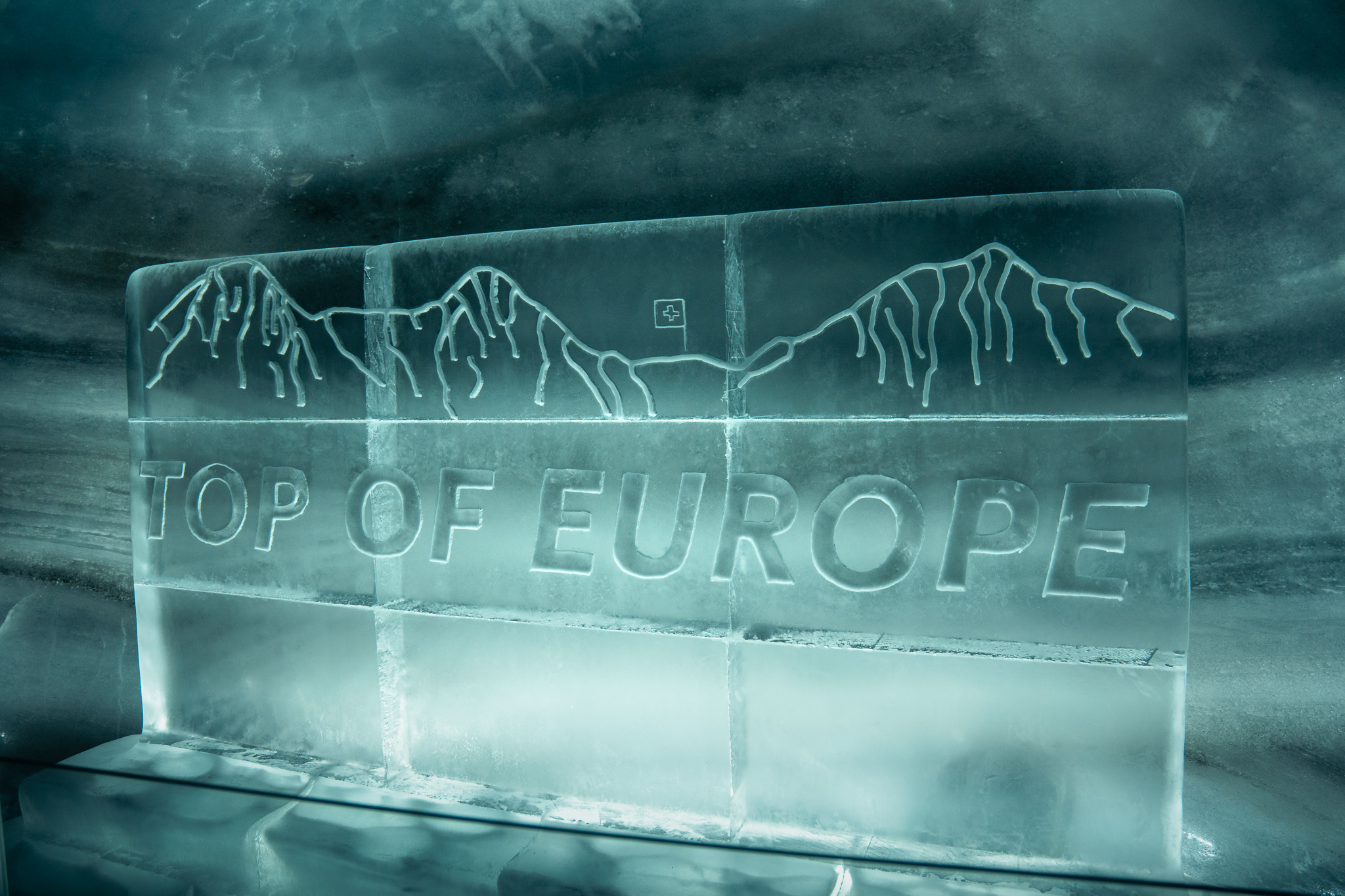
The floor can be a little slippery, so we’d recommend taking your time and wearing shoes with good grip. Crampons aren’t allowed inside, although you don’t need them anyway. If you’re traveling with children, we think this can be one of the most entertaining parts of the visit.
As a little piece of history, the Ice Palace was originally created in the 1930s by local mountain guides, who carved the tunnels by hand using basic tools. It has been expanded and improved over the years.
Other Things to Do at Jungfraujoch
If you’ve visited our blog before, you’ll know that we love mountains and hiking, so of course we had to include a trail in this guide.
Hiking: Mönchsjochhütte from Jungfraujoch
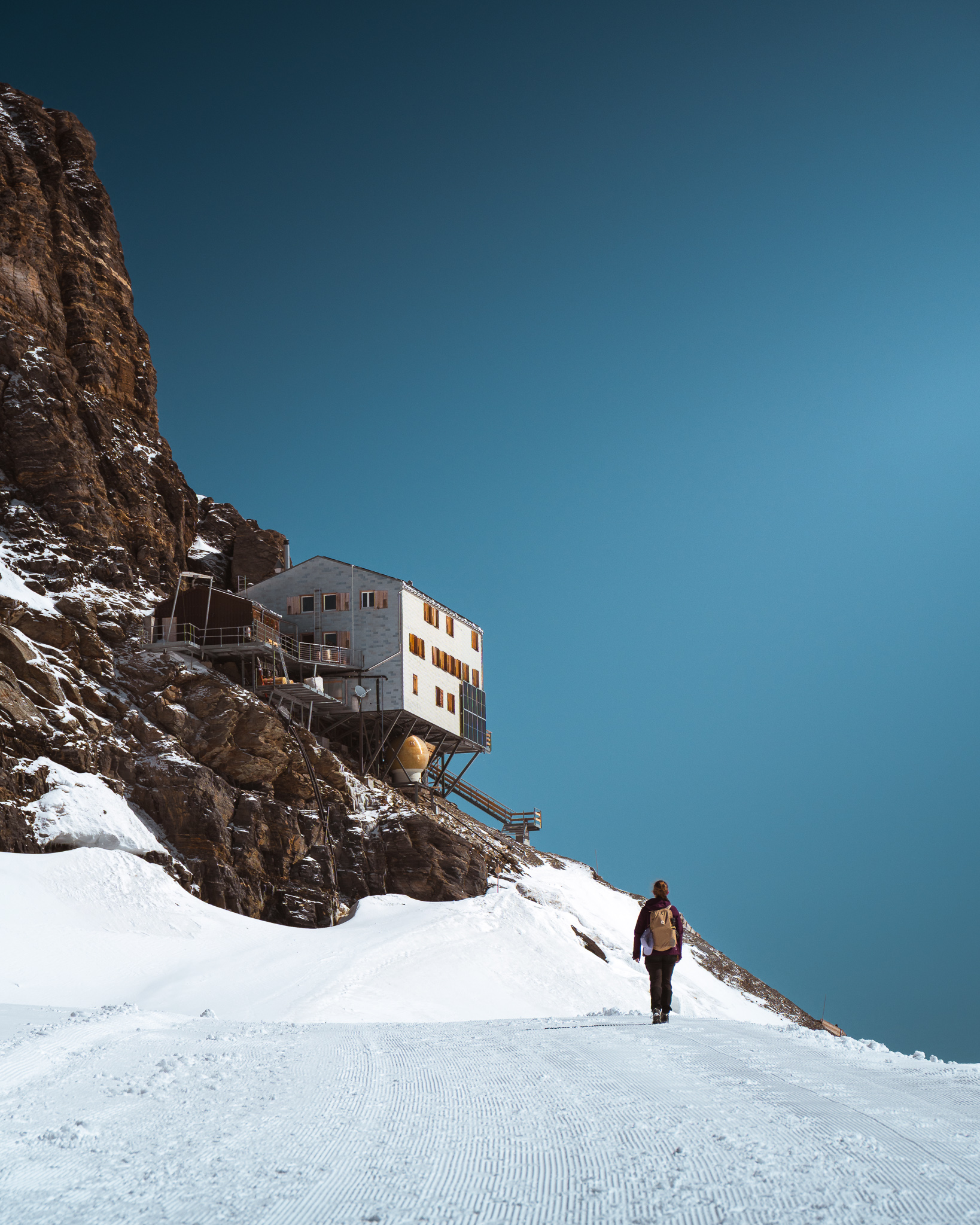
If you’d like to add a hike to your Jungfraujoch visit, the most accessible option is the walk to Mönchsjochhütte. When the tourist track has been prepared and is officially open, the route is straightforward, clearly marked across the snow and does not require technical mountaineering equipment. It is a fantastic way to get away from the main station for a while and walk through a genuine high-alpine landscape surrounded by glaciers and 4,000-meter peaks.
Important: always check the official trail status before setting off. When the tourist track has been prepared and is open, the route is straightforward. Outside those conditions, however, the access is considered a high-Alpine path: there may be crevasses, deep snow, avalanche risk or storms, and it is no longer a route for inexperienced hikers without proper high-alpine equipment. The trail can be closed at any time for safety reasons.
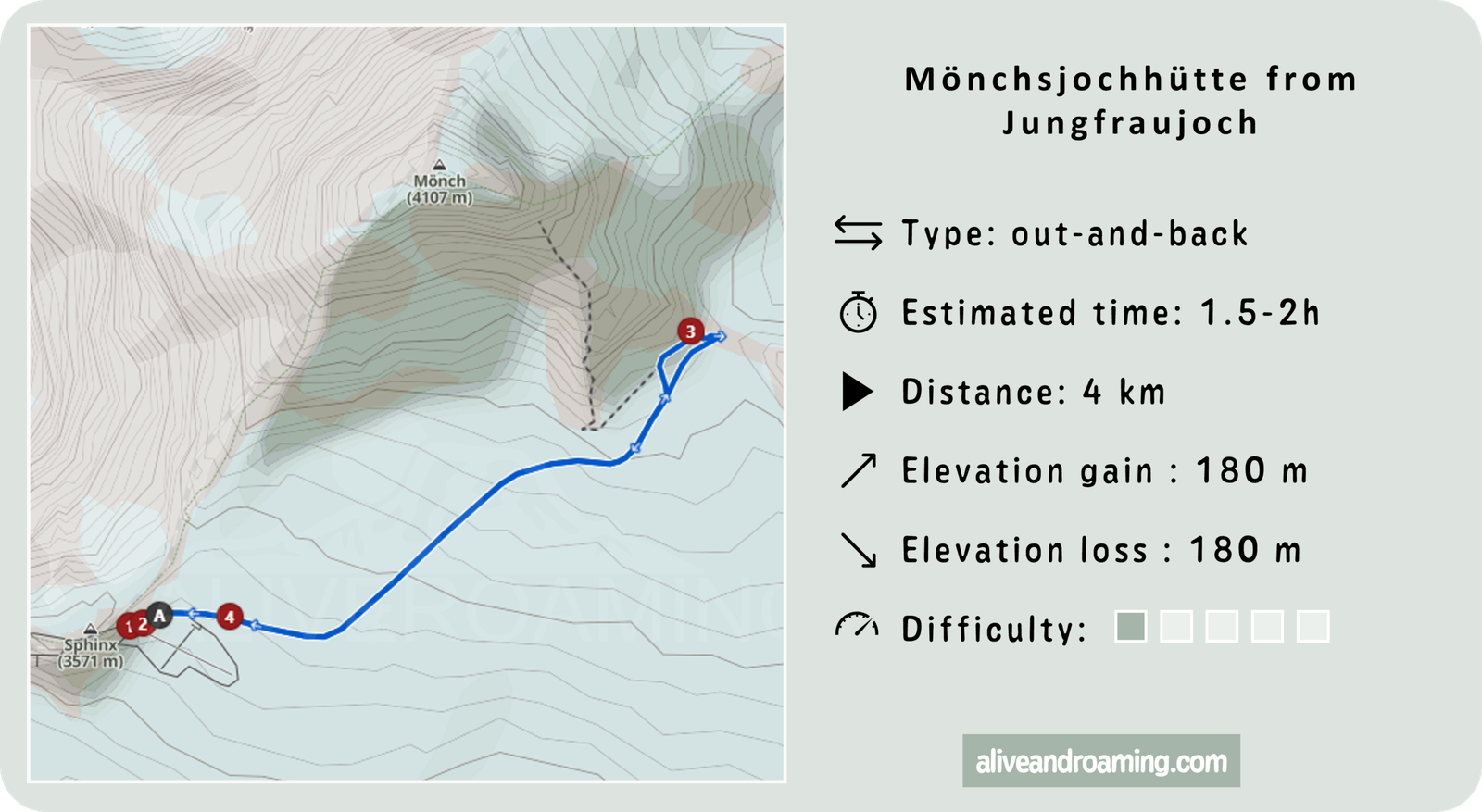
The hike is short, but the high-mountain scenery around it is spectacular. Mönchsjochhütte is around 2 kilometers from the station and roughly 200 meters higher than Jungfraujoch. If you’re interested, the hut is the only place to stay overnight in this area and is also a good place to stop for something to eat or drink. It is usually much quieter than the restaurant area at the main station and, when we visited, the prices seemed more reasonable too.
As for difficulty, when the track is prepared and conditions are good, we found it an easy hike. We recommend waterproof hiking boots, warm layers and a windproof jacket. It took us a little under an hour to reach the hut from the station because we walked at a relaxed pace, stopped for photos and enjoyed the scenery. The official reference time is around 45 minutes uphill, although the altitude can easily make you walk more slowly than usual.
When the prepared track is open, we also think the hike can be suitable for children who are already used to walking in the mountains and on snow. You still need to judge the conditions on the day and keep the altitude in mind: you’ll be above 3,400 meters, so it is normal to tire more quickly or feel a little weaker than usual.
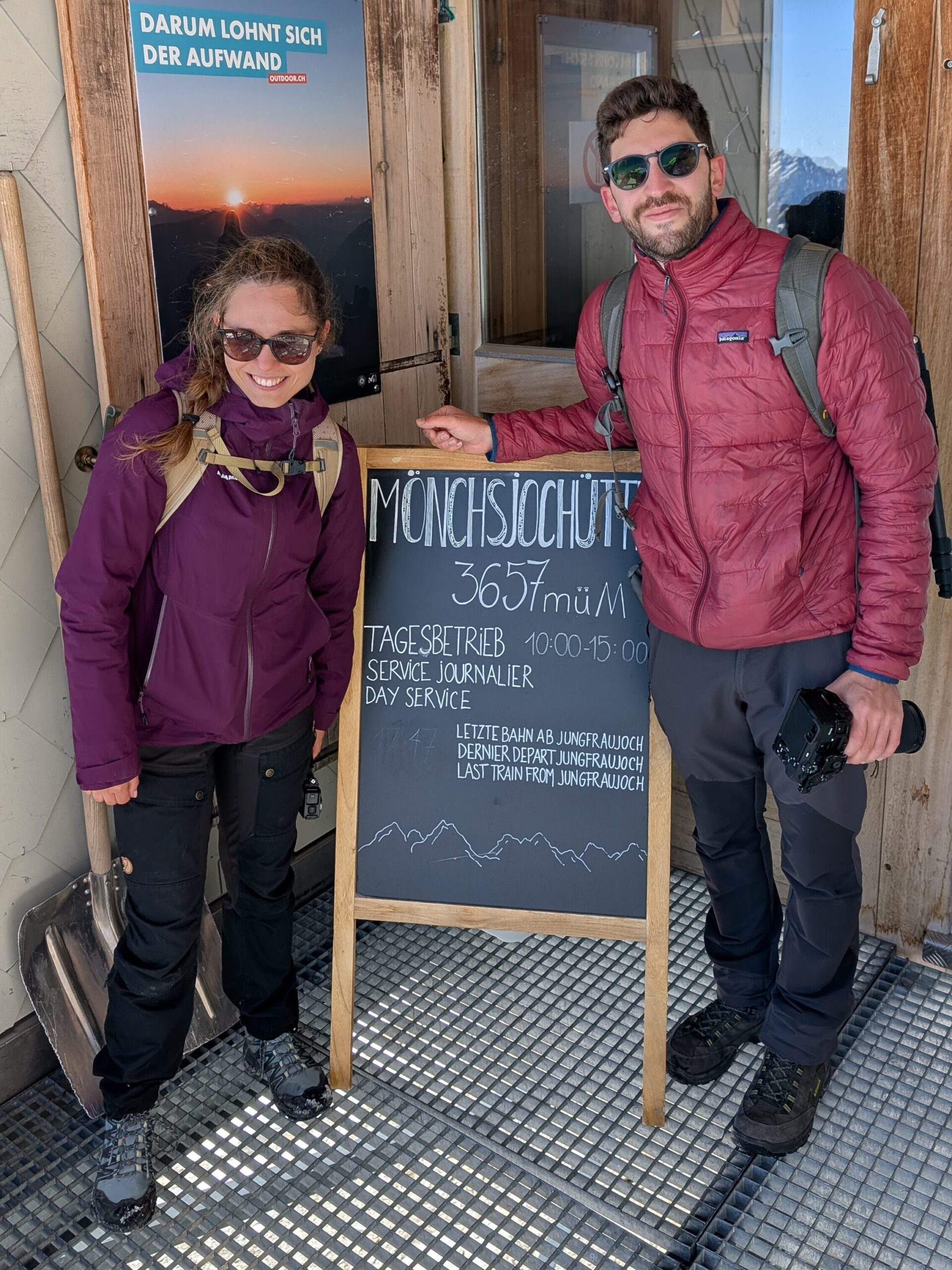
The hut can be a great place to have lunch or stop for a coffee or hot chocolate.
Snow Fun Park
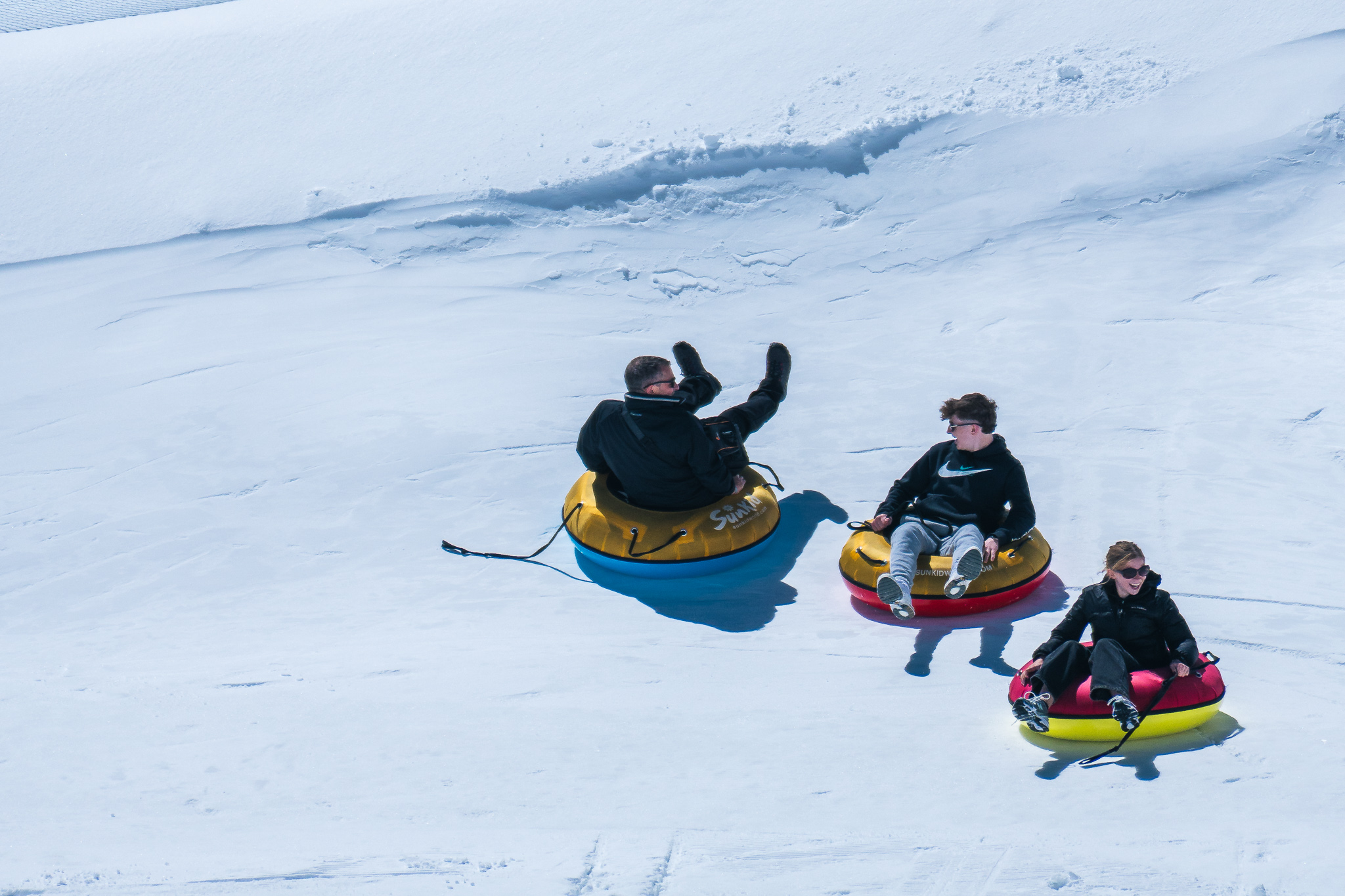
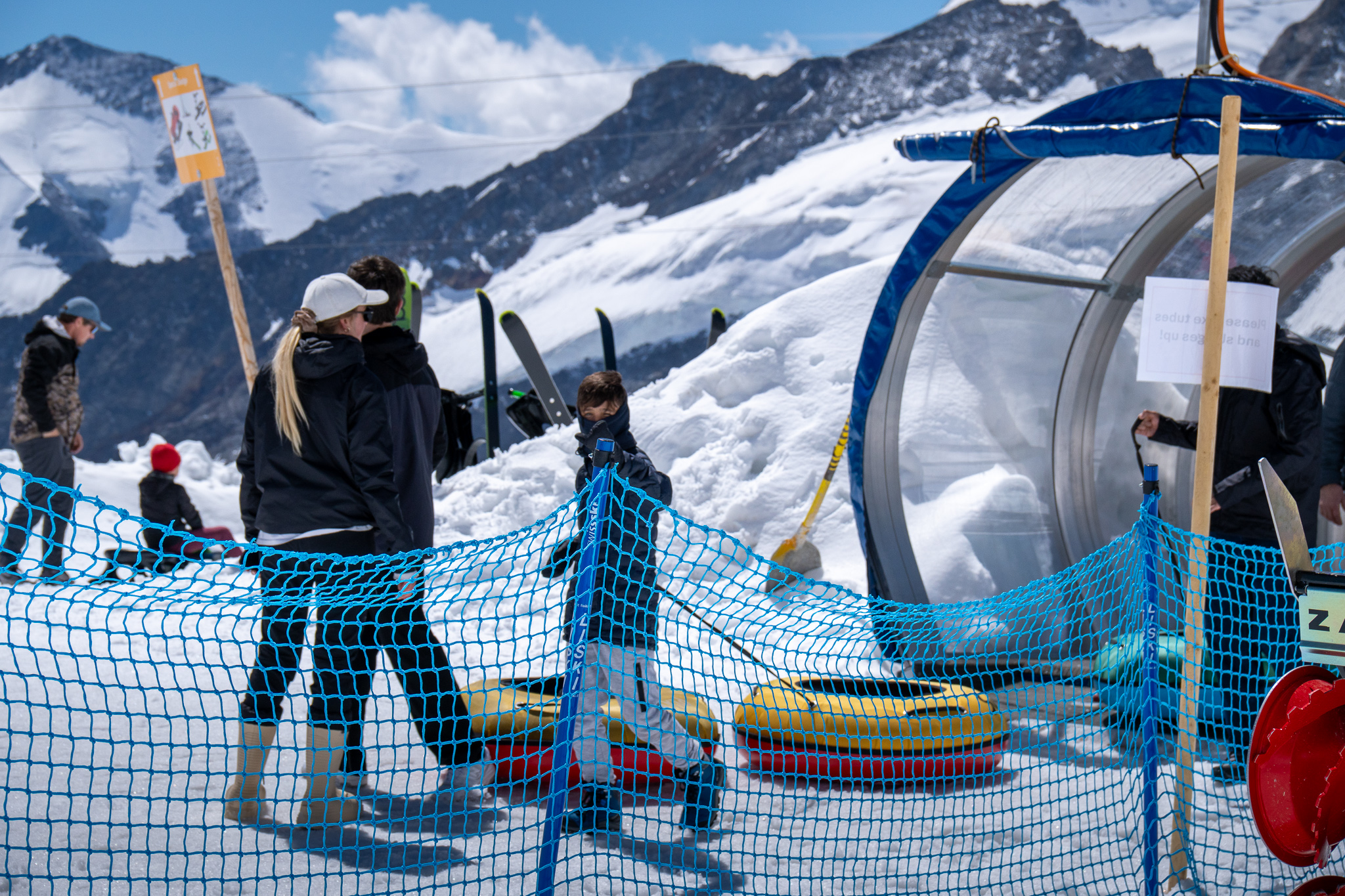
If you’re traveling with children, or simply feel like doing something different and adding a little adrenaline to the day, you can include a stop at the Snow Fun Park during your Jungfraujoch visit. This outdoor area operates seasonally and opening depends on snow conditions. In 2026, it is scheduled to open from May 4 to October 18, from 11:00 a.m. to 4:30 p.m. Activities include a zipline over the glacier, sledding and tubing, plus skiing and snowboarding.
We didn’t try any of these activities ourselves, but they can be a fun extra to add to your Top of Europe visit.
The Snow Fun Park requires separate tickets and is not included in the Jungfraujoch fare. In 2026, the zipline costs CHF 20 per adult and CHF 15 per child aged 6–15; sledding and tubing costs CHF 20/15; and skiing or snowboarding costs CHF 35/25. As prices and opening dates can change, we recommend checking the official information before your visit.
Mountaineering: Climbing the Mönch
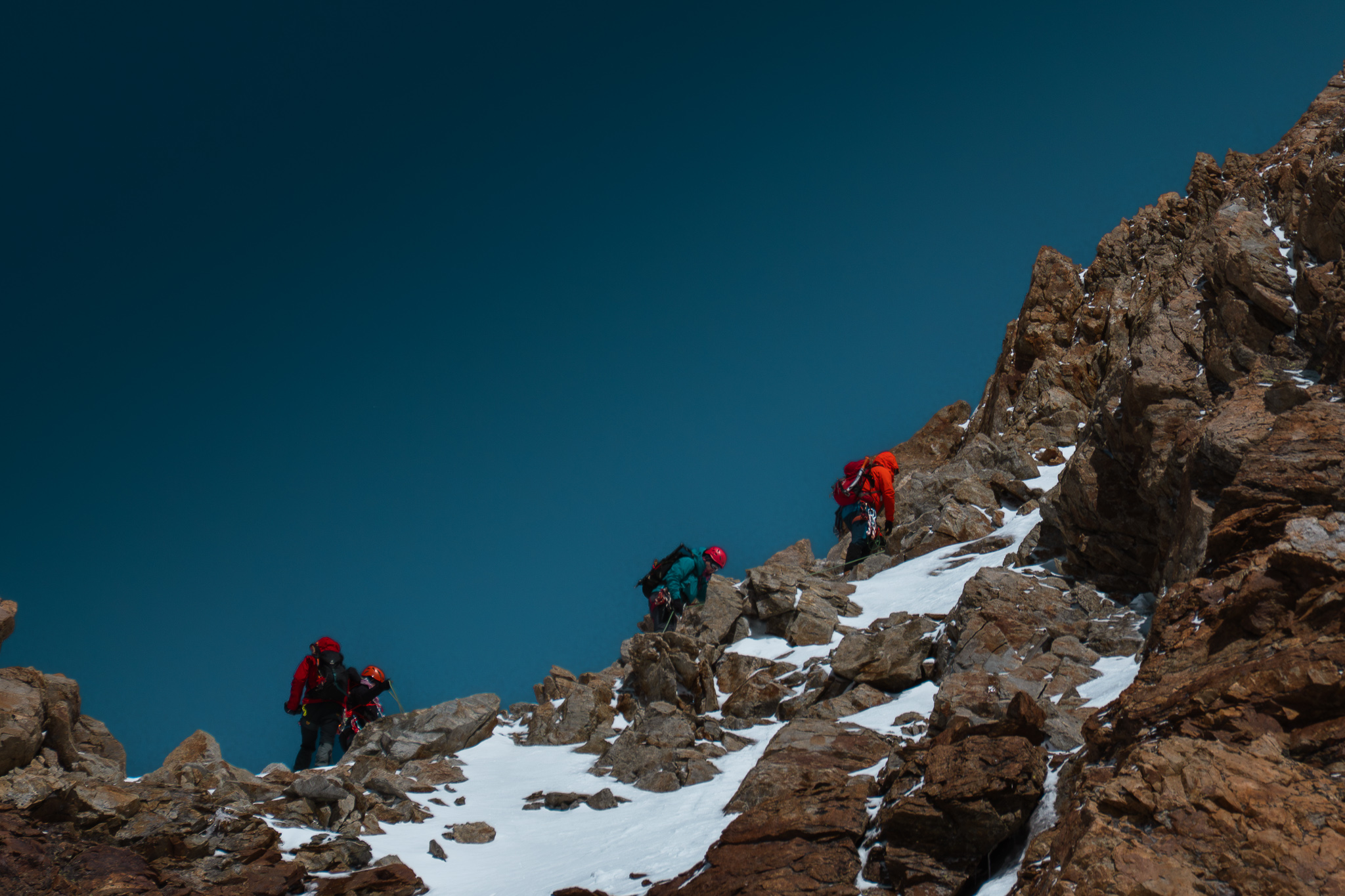
We also wanted to include a short section on a less common but very special mountaineering activity: climbing the Mönch (4,107 m), one of the 4,000-meter peaks that dominates the landscape from Jungfraujoch.
Climbing the Mönch is not a hike and it is not an easy ascent. Its main advantage is that you start from an already very high altitude, which reduces the elevation gain considerably compared with many other 4,000-meter peaks. The normal route is graded AD− by the Swiss Alpine Club and combines glacier travel, crampons, scrambling and an exposed final ridge. For someone who is physically fit, it can be a first 4,000-meter mountaineering experience, but we recommend going with a certified mountain guide if you do not have sufficient experience.
The normal route involves around 650 meters of elevation gain, and the Swiss Alpine Club estimates 3–4 hours for the ascent alone, before adding the descent. The surroundings are spectacular, but this is an activity that requires preparation, good fitness and experience in alpine terrain.
If you’d like to do this climb and don’t have enough mountaineering experience, our recommendation is to hire a certified mountain guide and check the current route conditions before setting out.
Important: this is not a hiking trail. Climbing the Mönch is a mountaineering activity that requires high-mountain experience, appropriate equipment and the ability to move safely on glaciers and exposed terrain. Equipment includes, among other things, crampons, an ice axe, harness, rope and the appropriate protection for the conditions.
Hiking: Jungfrau Eiger Walk from Eigergletscher to Kleine Scheidegg
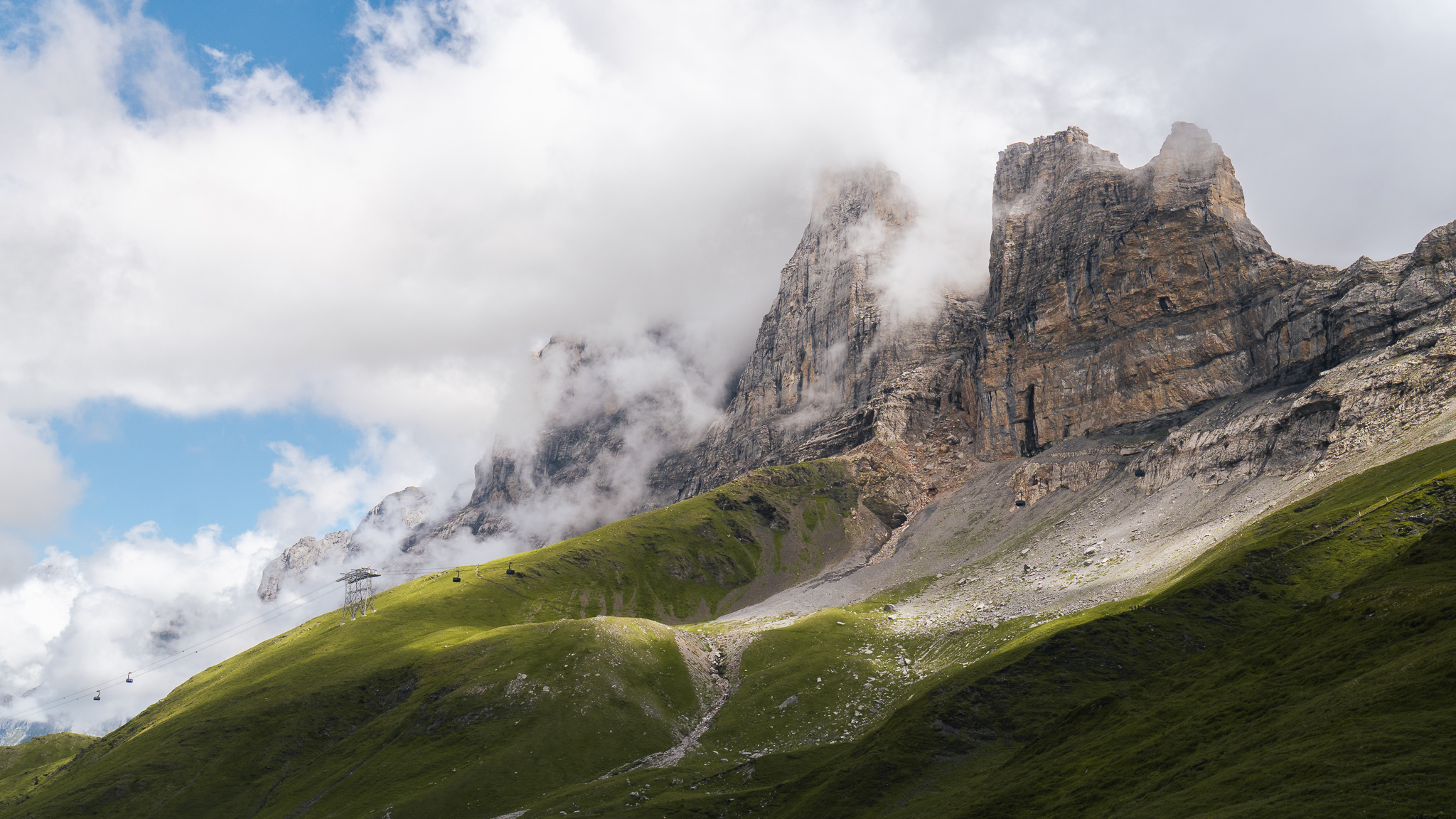
Kleine Scheidegg is the hiking area sitting directly below the three legendary mountains: the Eiger, Mönch and Jungfrau. It is a beautiful landscape where intensely green alpine meadows and wildflowers contrast with huge walls of rock and ice.
There are, of course, plenty of hikes in this area, from short walks to much longer routes. We planned a very short downhill hike that combined perfectly with our Jungfraujoch visit. You can also come up here and do the hike without visiting Jungfraujoch at all.
Our recommendation is this: if you’re traveling down from Jungfraujoch by train, stop at Eigergletscher station. From here you can follow the Jungfrau Eiger Walk to Kleine Scheidegg, a well-maintained trail of around 2.5 km that takes roughly one hour. In this downhill direction, we found it a beautiful and very easy walk.
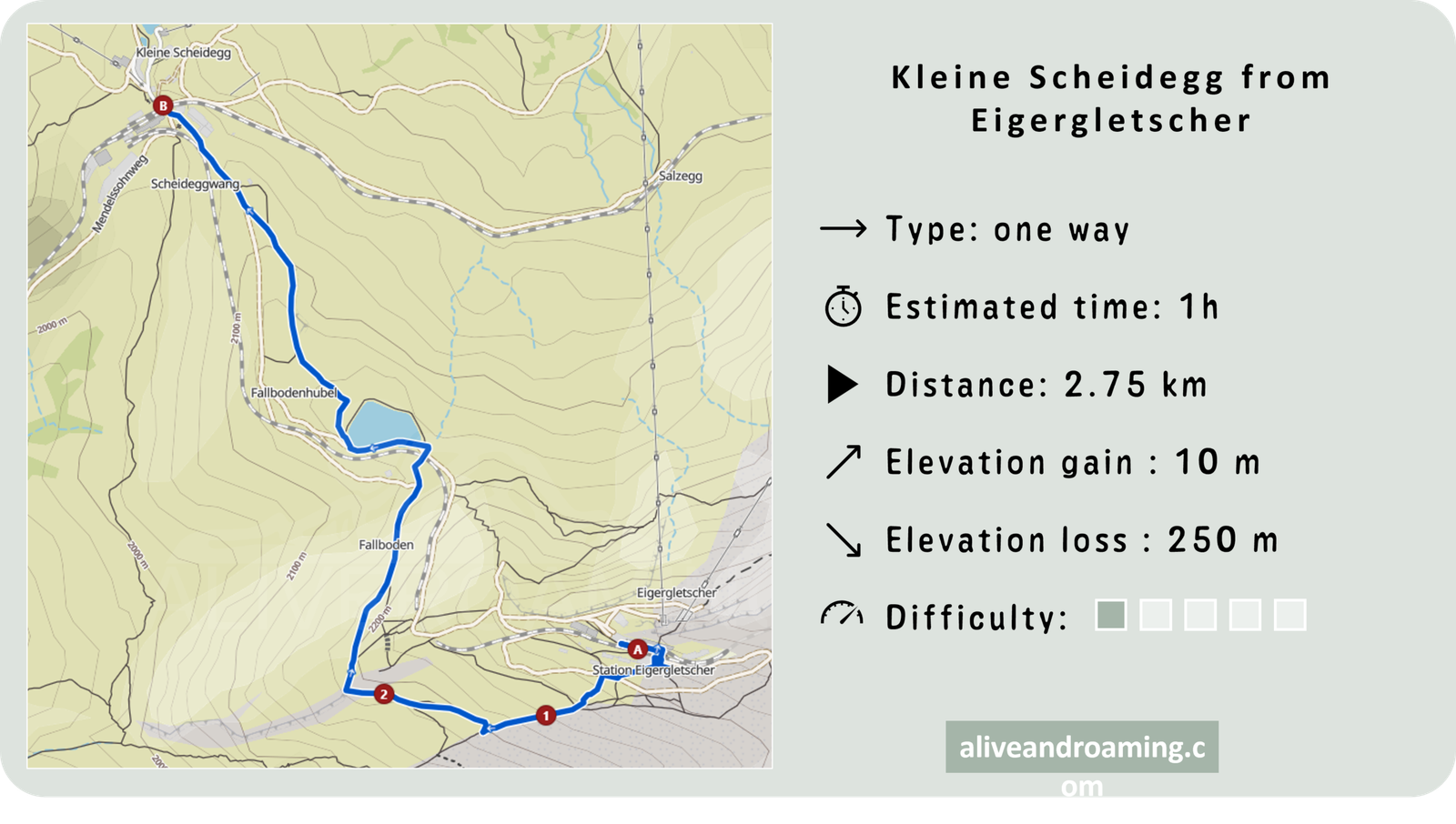
The idea behind this walk is to follow a small ridge with excellent views of the famous north face of the Eiger, one of the best-known and most feared walls in mountaineering history.
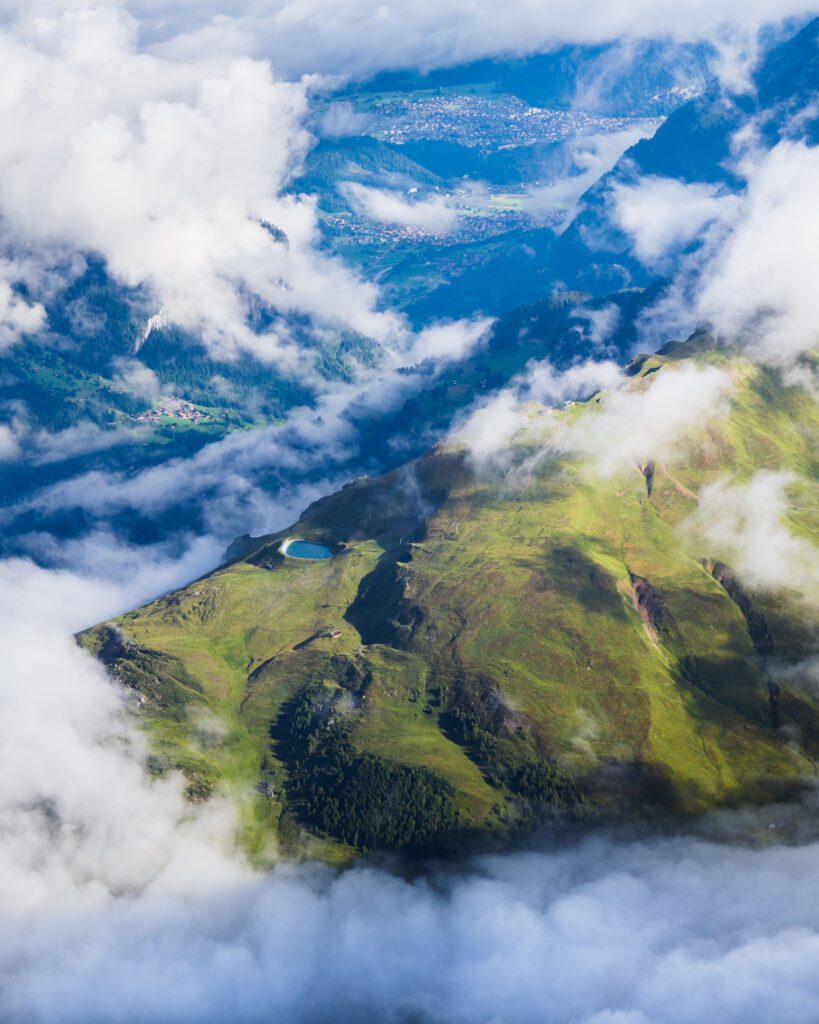
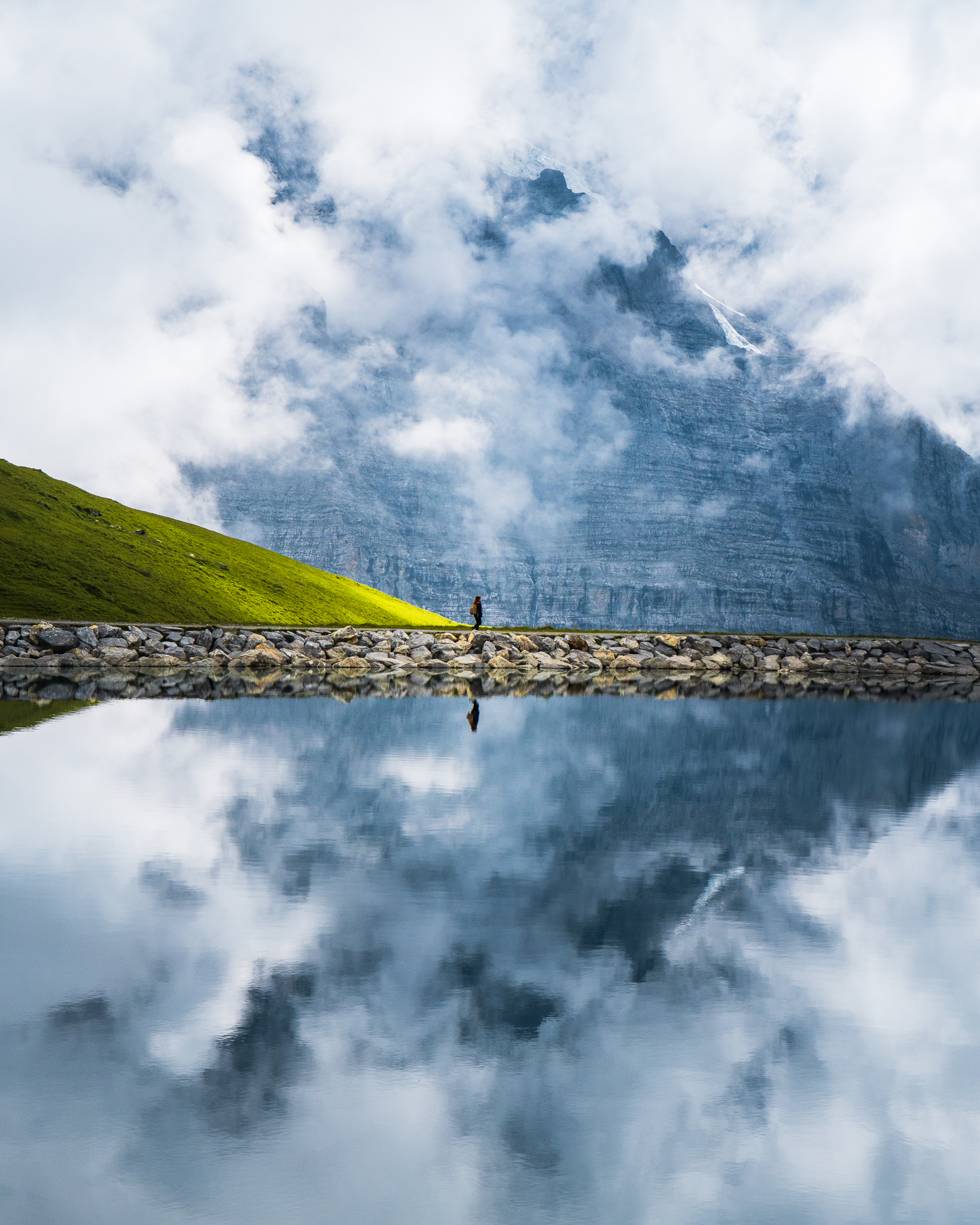
On the way to Kleine Scheidegg station, you’ll pass a small artificial lake called Fallbodensee. It is a beautiful and surprisingly little-known spot in Switzerland that we have really good memories of. Below is one of our favorite photos from the trip, taken at the lake.
How to Get to Jungfraujoch – Top of Europe
There are no roads to Jungfraujoch, the highest railway station in Europe, so the only way to reach it is by train. The full journey involves several different trains, depending on where you start. Below, we explain the route step by step.
Common starting points include:
- Interlaken
- Lauterbrunnen
- Grindelwald
From all of them, you’ll eventually connect with the Jungfrau Railway, the cogwheel train that operates the final section to Jungfraujoch. If you take the Eiger Express from Grindelwald Terminal, you change at Eigergletscher. If you choose the traditional route from Grindelwald or Lauterbrunnen, you’ll travel via Kleine Scheidegg before continuing to Eigergletscher and Jungfraujoch.
From Grindelwald, there is a faster alternative to the traditional train route: the Eiger Express gondola. It runs directly from Grindelwald Terminal to Eigergletscher, where you transfer to the train for Jungfraujoch.
Important for 2026: between May 1 and October 31, seat reservations are mandatory for travel to Jungfraujoch and cost CHF 10 per person. The reservation applies to the Jungfrau Railway journey and secures your selected time slot. Outside these dates, a reservation is not mandatory, although it is still recommended on busy days.
To buy your ticket:
- If you want to organize your Jungfraujoch visit independently, you can buy your ticket on the official Jungfraujoch – Top of Europe website.
- If you prefer a guided tour in Spanish, we recommend this Jungfraujoch excursion from Civitatis and Best of Switzerland.
Stops Along the Way
On your way to and from Jungfraujoch, the route passes several intermediate stations that are worth paying attention to. Within the same day, you can interrupt your journey and continue later, for example to spend some time at Eigergletscher or Kleine Scheidegg. If you’ve reserved a seat, however, you’ll need to respect your booked time slot for the section toward Jungfraujoch.
The seat reservation applies to the Jungfrau Railway section accessing Jungfraujoch from Eigergletscher or Kleine Scheidegg. If you’re using the Eiger Express, the reservation also helps secure the planned connection from Grindelwald Terminal.
Eismeer Station – Sea of Ice
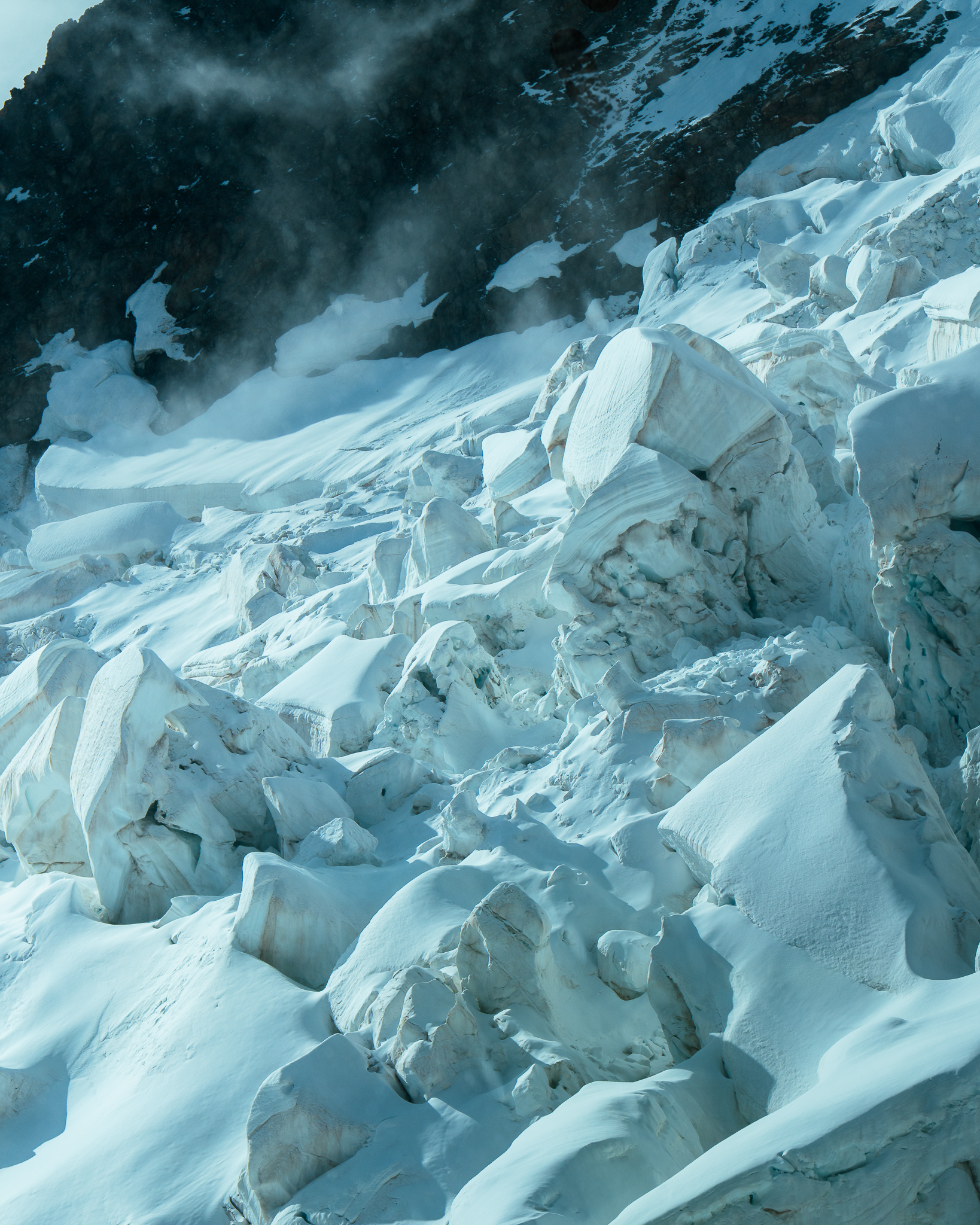
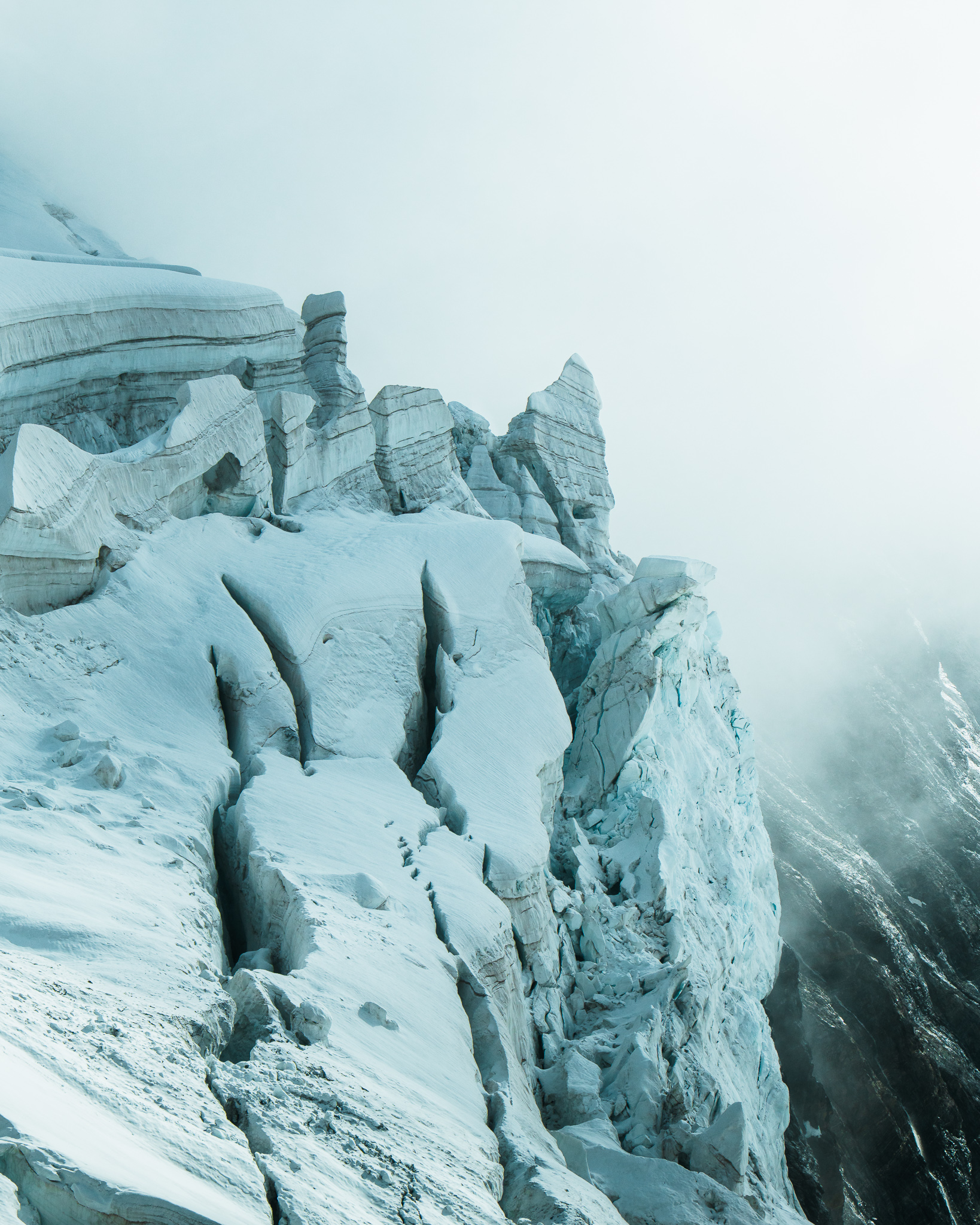
One of the most unusual stops is Eismeer, which literally means “sea of ice” in German. The station sits at around 3,160 meters above sea level and is carved into the mountain. Through its large windows, you get impressive views over the Ischmeer Glacier and the high-alpine landscape around it.
In our case, the train made a short stop of a few minutes during the journey up to Jungfraujoch (Top of Europe), giving passengers enough time to step off and look through the large windows at the glacier.
It is a unique opportunity to see a glacial landscape from inside the mountain, and it adds another interesting moment to the Jungfraujoch journey.
Eigergletscher Station – Eiger Glacier
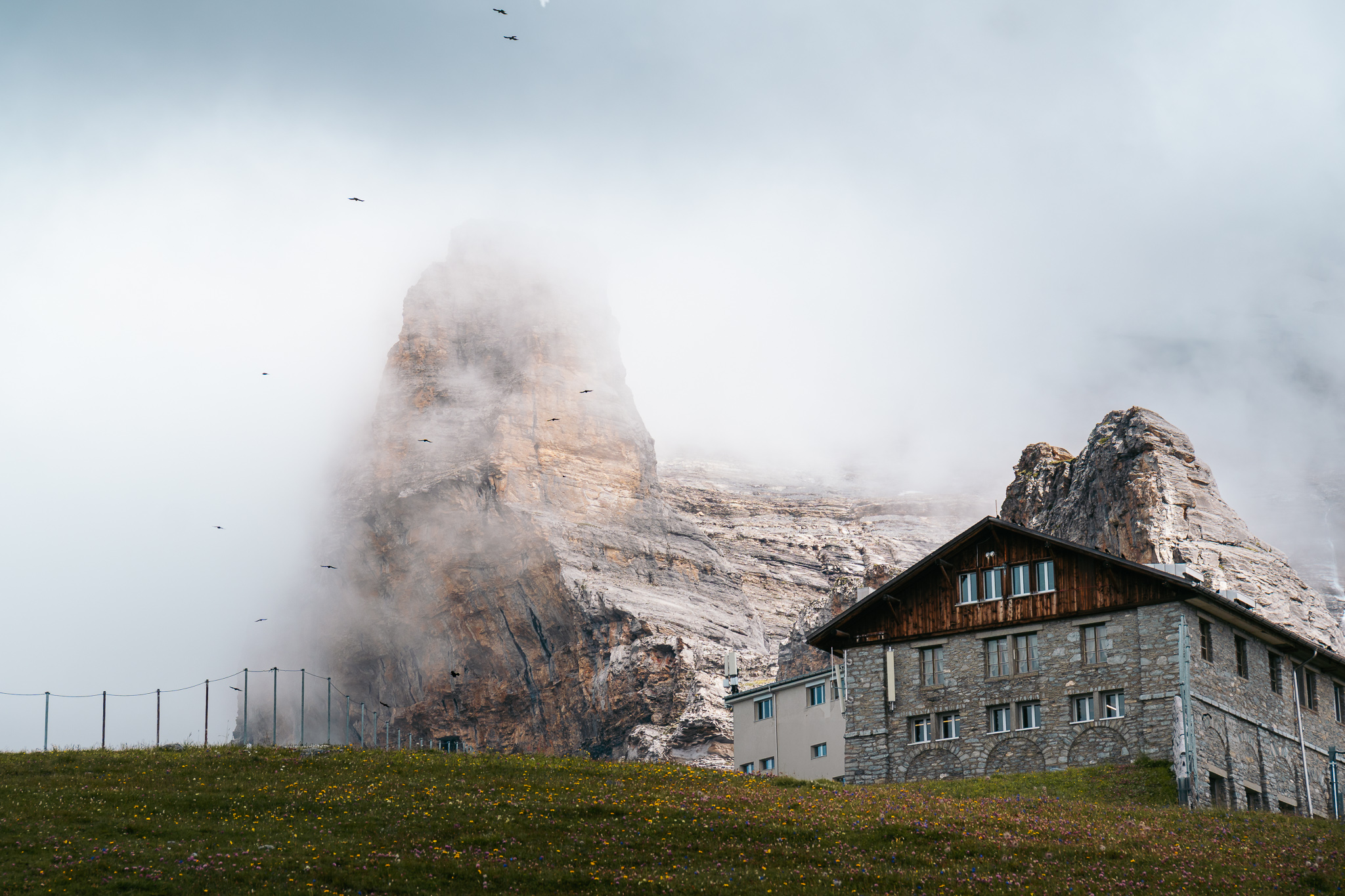
The next interesting stop is Eigergletscher station, at around 2,320 meters above sea level. It is the final station before the train enters the Eiger tunnel on its way to Jungfraujoch.
If you have time and want to extend your day, you can use this stop to hike down to the next station, Kleine Scheidegg, as we explained earlier. For us, it was the perfect way to round out our Jungfraujoch visit.
Kleine Scheidegg Station
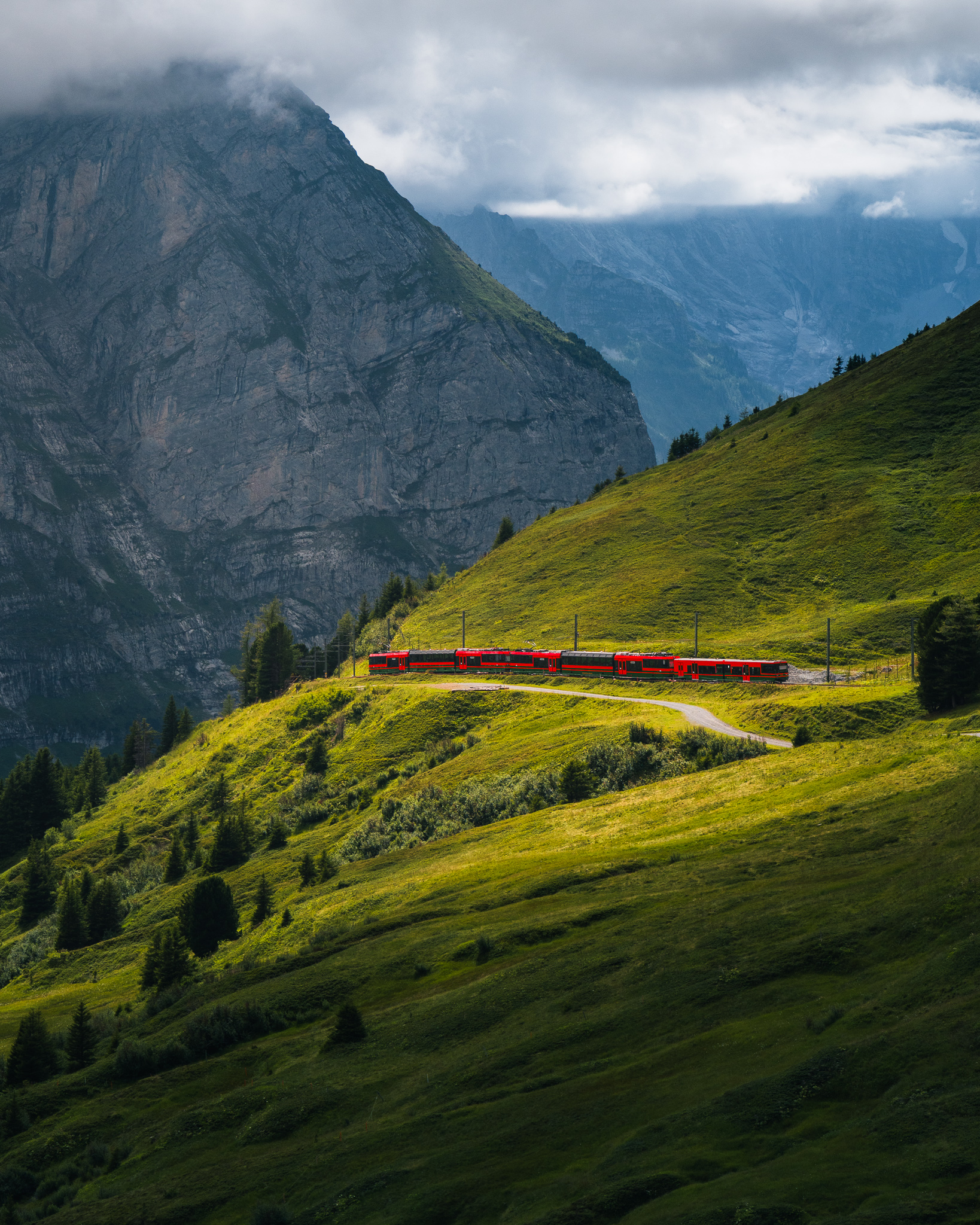
This station sits between the trains heading up toward Jungfraujoch and those descending toward Grindelwald or Lauterbrunnen. It is also where your walk finishes if you decide to hike from Eigergletscher to Kleine Scheidegg.
Guided Tours to Jungfraujoch
A guided excursion can be a very good option if you’d rather not worry about train schedules, connections or buying the different tickets yourself. Tours depart from several places around Switzerland and include transport and the Jungfraujoch ticket, allowing you to relax and focus on enjoying the experience.
We recommend Civitatis for this type of activity because they offer several options that are easy to book online. They also offer free cancellation up to 24 hours in advance on these tours.
- Jungfraujoch tour from Zurich.
- Jungfraujoch tour from Interlaken.
- Jungfraujoch tour from Lucerne.
- Jungfraujoch tour from Geneva.
Where to Stay for Jungfraujoch
We think one of the keys to visiting Jungfraujoch without rushing or adding unnecessary stress is choosing a good place to stay, ideally somewhere well connected to the trains that take you up toward Top of Europe.
There are several good options depending on your preferences and budget. Below, we’ll share the places we would consider. This isn’t a cheap area, but accommodation still fills up in high season, so we’d recommend checking your options early enough to book the one that works best for you.
Staying in Grindelwald
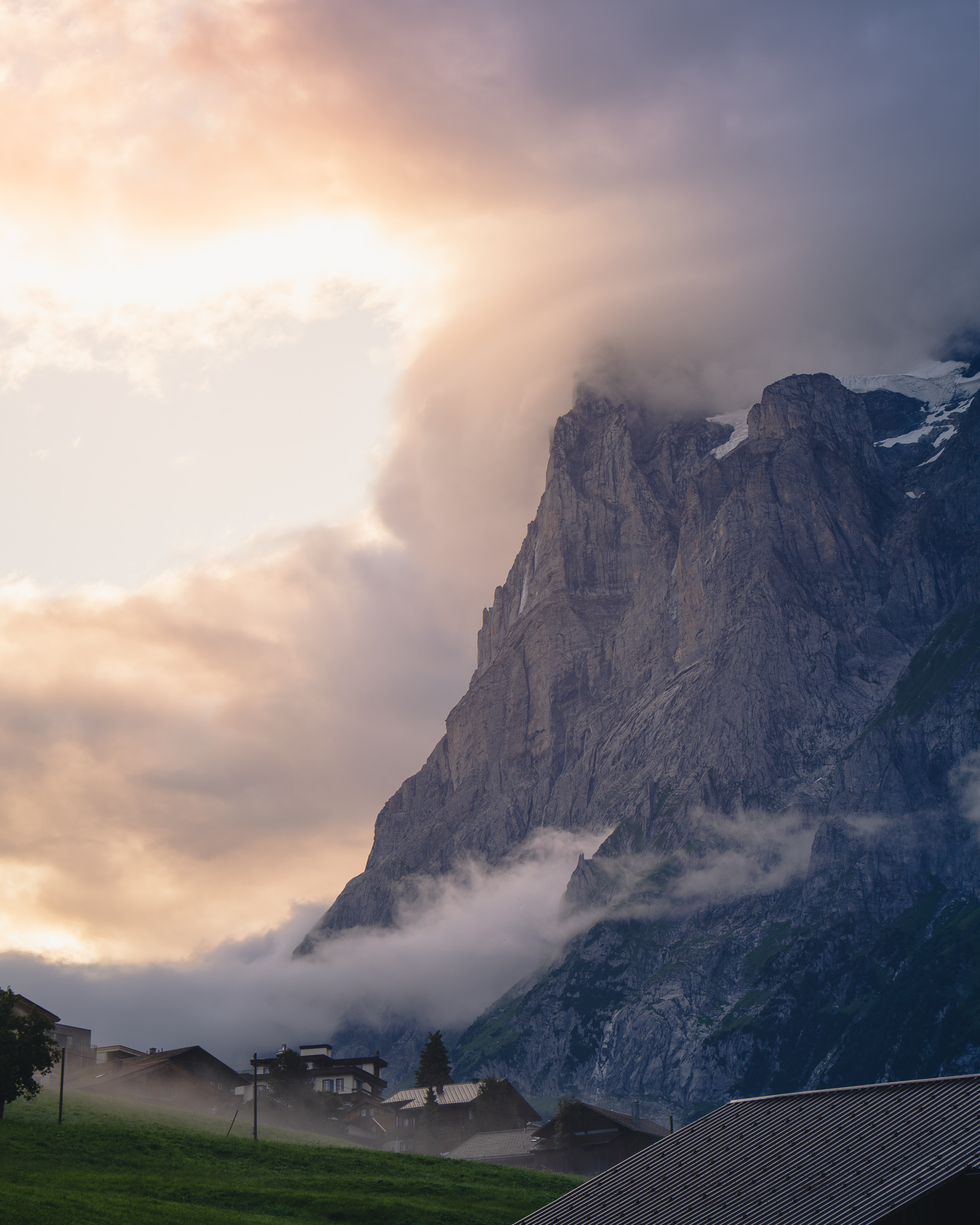
Staying in Grindelwald is our favorite option for visiting Jungfraujoch. It is very well connected, has plenty of accommodation, and the village has supermarkets, restaurants and spectacular mountain scenery.
The Eiger Express departs from Grindelwald Terminal and reaches Eigergletscher in around 15 minutes. From there, you transfer to the Jungfrau Railway for Jungfraujoch. It is the fastest and most convenient option from Grindelwald.
Below is our Booking link if you’d like to browse accommodation in Grindelwald.
Camping in Grindelwald
If you’re traveling by campervan or motorhome, or simply want to camp in a tent, there are also several options in the area. We stayed at Camping Gletscherdorf. It isn’t cheap, but very little in this area is, and the campsite is well located, clean and has beautiful views. From there, you can easily reach the center of the village or the train station.
If you’d rather compare other options, you can take a look at the camping.info page for Grindelwald.
Staying in Lauterbrunnen
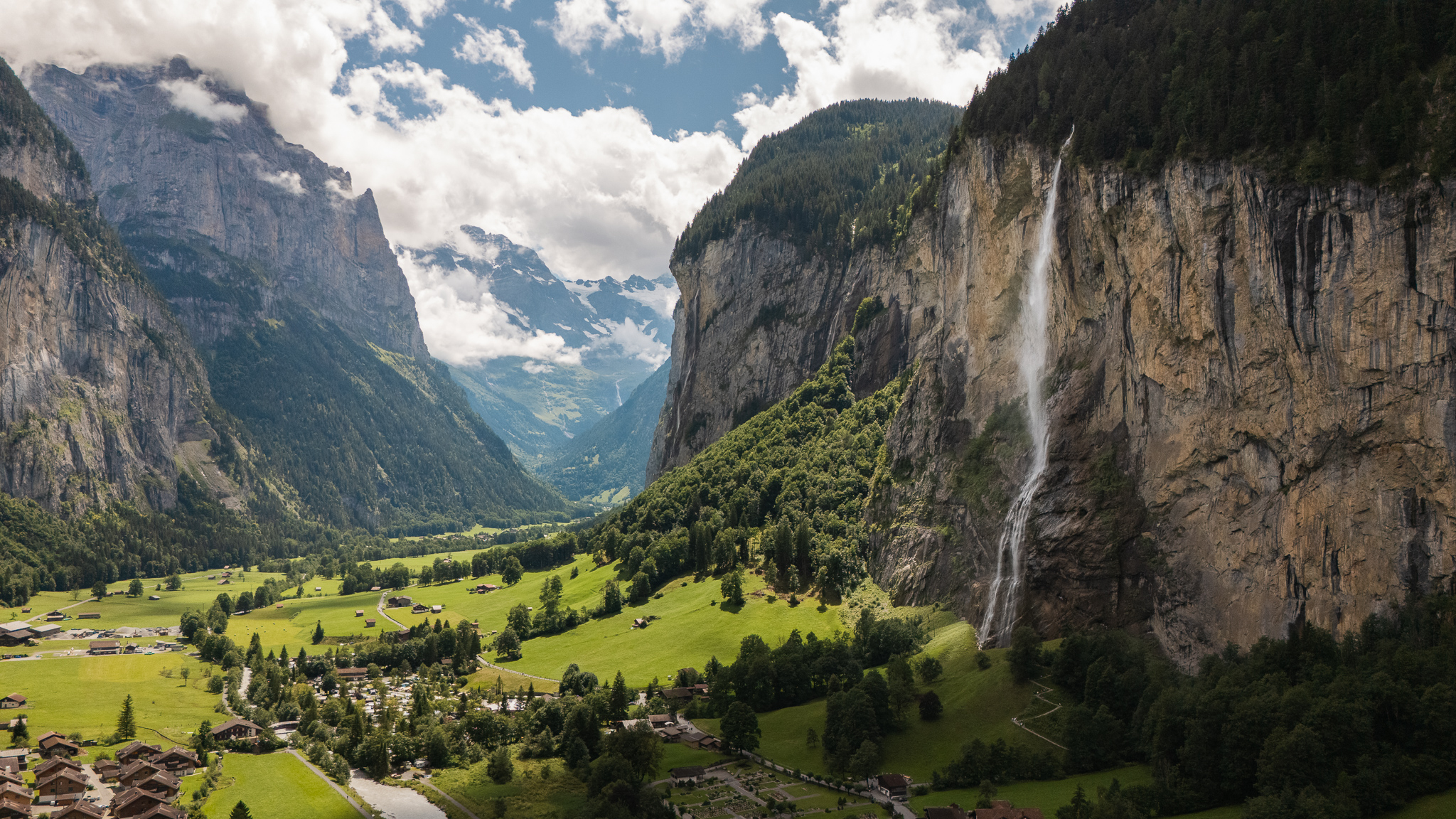
Lauterbrunnen is a very good option if you want to combine several valleys. We visited it from Grindelwald and think it is beautiful too. The valley is full of waterfalls, cliffs and green landscapes. It is well connected by train to Kleine Scheidegg and Eigergletscher, from where you can continue up to Jungfraujoch.
If you’re staying here and have enough time, we’d also recommend visiting Wengen and doing a hike either in the Lauterbrunnen Valley or around the little village of Mürren. We don’t think you’ll be disappointed.
Below is our Booking link if you’d like to browse accommodation in Lauterbrunnen.
Camping is also an option. If you’re traveling by campervan, motorhome or tent, we recommend Camping Jungfrau Lauterbrunnen.
Staying in Interlaken
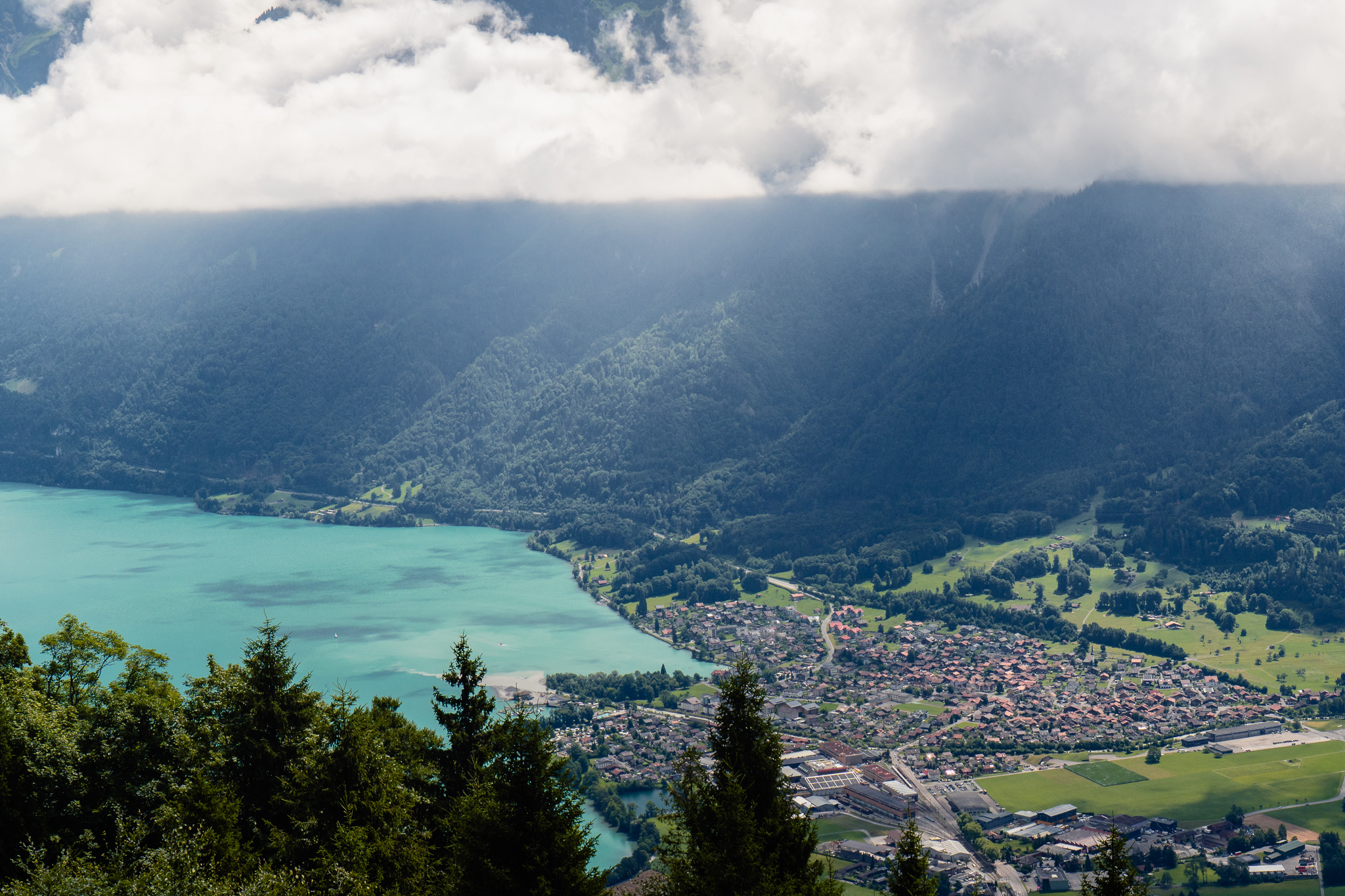
Interlaken usually offers a wider range of accommodation and, depending on the dates, can be a little cheaper. It also makes a lot of sense if you’re traveling without a car and plan to use public transport. Trains run frequently from here toward Grindelwald and Lauterbrunnen. The downside is that you’re farther away, so you’ll need to allow more travel time for Jungfraujoch.
Below is our Booking link if you’d like to browse accommodation in Interlaken.
There are lots of campsites around Interlaken, but keep in mind that many of them book up well in advance and it can be difficult to find a pitch, especially at the ones overlooking Lake Thun or Lake Brienz.
If you’re visiting this area, we’d also recommend Lake Brienz, the Harder Kulm viewpoint and, if you still have the energy and time, the Augstmatthorn hike. We’ll be adding more detailed guides to these places in the future.
Tips for Visiting Jungfraujoch
Visiting Jungfraujoch can be an unforgettable experience, but we think it can also become a little overwhelming if you don’t plan a few things in advance. And because it is anything but cheap, we want this guide to help you get as much as possible out of the day. Here are some tips based on our experience and what we’ve seen from other travelers.
Avoid the Crowds: Go Early
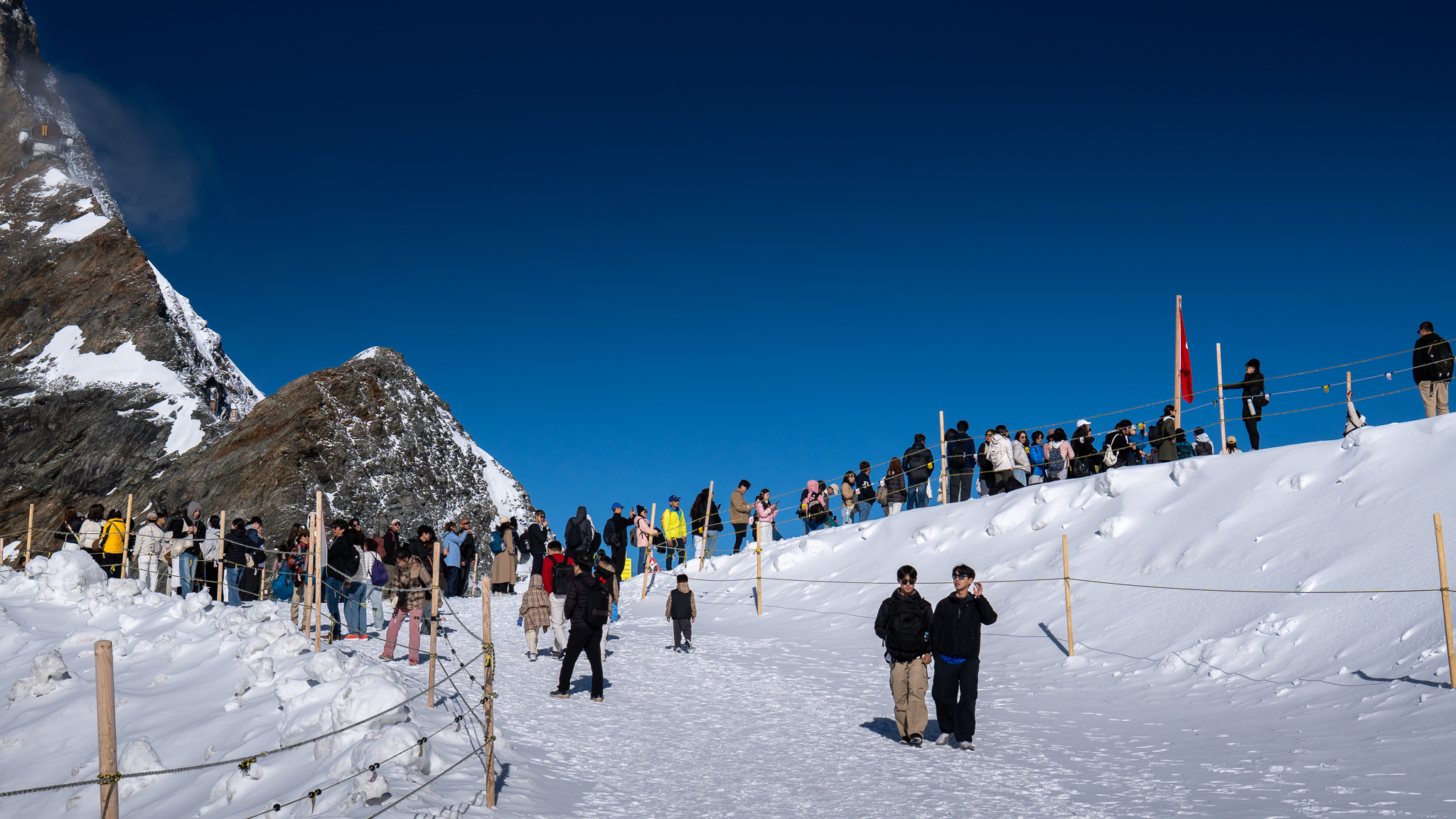
Despite the price, Jungfraujoch is a very, very touristy attraction. If you’re visiting during the summer high season in particular, you should expect it to be busy, especially from around midday onward.
That’s why we’d recommend taking one of the first connections of the morning. In 2026, there is also a Good Morning Ticket, available from May 1 to October 31 and valid only on the first two connections of the day to Jungfraujoch. The exact departure times depend on where you begin the journey, so check the official website when booking.
That’s exactly what we did, and it worked brilliantly. We were able to enjoy the attractions and viewpoints with hardly anyone around. As the morning went on, everything became noticeably busier: the restaurant area was packed, queues started appearing everywhere and the whole experience became much less comfortable.
After our hike to Mönchsjochhütte, at around 1:00 p.m., we returned to the station and found the viewpoints absolutely packed. We had already enjoyed the views and indoor attractions earlier in the morning, so at that point we decided to leave Jungfraujoch and do the hike from Eigergletscher to Kleine Scheidegg instead. For us, that was definitely the right decision.
If you’re choosing between different times, our recommendation is simple: go up as early as you can and come back down earlier.
Save Money with Travel Passes and Discounts
We’re not going to pretend otherwise in this guide: Jungfraujoch is expensive. The final price depends on where you start, the season and any passes or discounts you have, and a full-fare return ticket from some locations can come close to CHF 250 per adult. Fortunately, there are several ways to reduce the cost considerably. Here is a summary of the main options worth considering:
| Pass or Ticket | How it Helps for Jungfraujoch | Best For |
|---|---|---|
| Swiss Travel Pass | Covers much of your public transport journey and gives you a reduced fare on the mountain section toward Jungfraujoch. | Multi-day trips using a lot of public transport around Switzerland. |
| Jungfrau Travel Pass | Covers much of the regional network and lets you buy a connecting ticket to Jungfraujoch with up to 50% off. | Several days in the Jungfrau region visiting First, Schynige Platte, Harder Kulm and more. |
| Swiss Half Fare Card | Up to 50% off transport, including the journey to Jungfraujoch. | Trips around Switzerland involving several train and mountain journeys. |
| Good Morning Ticket | Special fare for the first two connections. You must leave Jungfraujoch no later than the 1:17 p.m. train. | Travelers who want to go very early and aren’t using another incompatible discount. |
| Berner Oberland Pass | Covers a large part of the regional journey and offers a reduced fare for continuing to Jungfraujoch. | Trips focused mainly on the Bernese Oberland. |
- Swiss Travel Pass: this pass gives you unlimited travel on much of Switzerland’s train, bus and boat network for several days, plus discounts on many mountain trains and cable cars. It doesn’t cover the entire Jungfraujoch journey, but it includes transport through part of the region and gives you a reduced fare on the mountain section. The exact conditions depend on the route you choose, so we recommend checking the final price when selecting your pass. You can also see the official Swiss public transport page here.
- Jungfrau Travel Pass: this pass covers much of the train, gondola and transport network in the Jungfrau region for several days. It doesn’t fully include the journey to Jungfraujoch, but it allows you to buy a connecting ticket with up to 50% off. During the 2026 summer season, the connecting ticket starts from CHF 89 and includes the mandatory seat reservation. It can be a particularly good option if you’re spending several days in the area visiting places such as Grindelwald First, Schynige Platte or Harder Kulm. You can check current prices and conditions on the official Jungfrau Travel Pass page.
- Swiss Half Fare Card: this visitor pass costs CHF 150 and is valid for one month. It allows you to buy most train, bus and boat tickets, plus many mountain transport tickets, at half price or a reduced fare, including the journey to Jungfraujoch. If you’re moving around Switzerland quite a lot, it can pay for itself surprisingly quickly. During the years we lived in Switzerland, we used the annual Half Fare Travelcard and it was one of the passes we got the most use out of. You can check the conditions and buy the visitor version on the official SBB website.
- Good Morning Ticket: available from May 1 to October 31, 2026 for the first two connections of the day. It offers a special fare if you’re paying the full price, but it cannot be combined with discounts such as the Swiss Half Fare Card, Swiss Travel Pass, GA, Eurail or Interrail. To keep this fare, you must leave Jungfraujoch no later than the 1:17 p.m. train; after that, you can continue your journey from Eigergletscher or Kleine Scheidegg whenever you like.
- Swiss Family Card: if you’re traveling as a family, you can request this card free of charge when buying a Swiss Travel Pass or Swiss Half Fare Card. It allows children aged 6–15 to travel free when accompanied by at least one parent holding a valid pass. Keep in mind that the rules are different if you’re using the Jungfrau Travel Pass or Unlimited Jungfrau Summer Pass, where the same family reductions do not apply in exactly the same way.
Weather, Temperature and Forecasts
As we always say in our hiking guides, mountain weather is unpredictable, so we recommend being properly equipped for changing conditions. At Jungfraujoch, that matters even more. You might be wearing shorts in the valley in summer, but at more than 3,450 meters above sea level you’ll be in a true high-alpine environment, where temperatures can easily hover around freezing or drop below it, even in summer. Because of the altitude, snow is present here 365 days a year.
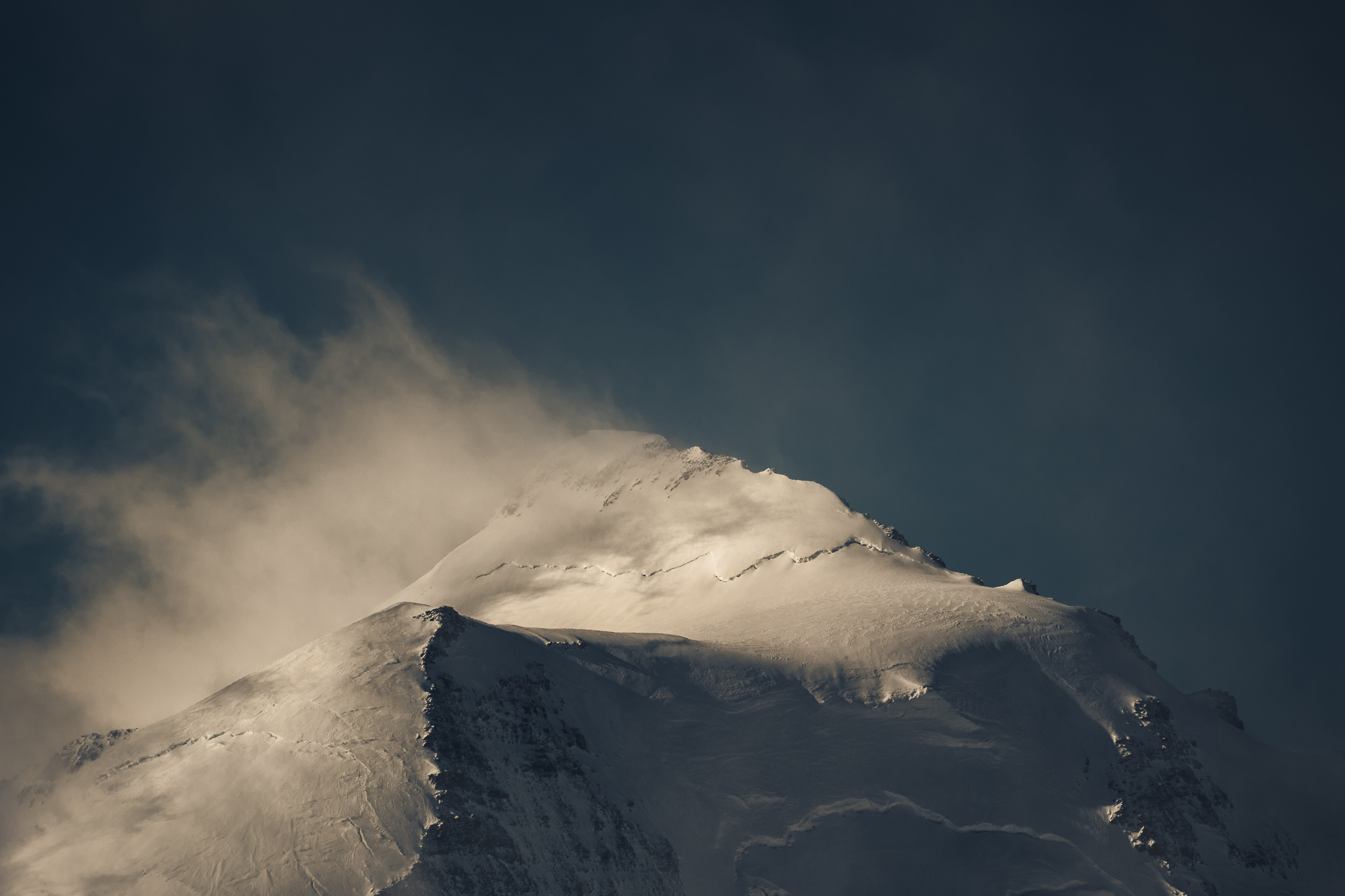
We recommend checking the forecast before your visit, because low clouds can hide a large part of the scenery that makes this trip so special. At the moment, tickets purchased through the official webshop can be canceled free of charge until 11:59 p.m. on the day before they become valid. Once the ticket is valid, it is no longer refundable. That gives you some flexibility to wait for a reasonably reliable forecast before deciding whether to keep the booking.
Some useful websites and apps we use are:
- The official Jungfraujoch website with live webcams.
- Switzerland’s official weather service: MeteoSwiss.
- And apps such as Windy, which also works very well.
What to Wear and Bring to Jungfraujoch
We’ve included this section because it is easy to underestimate what being above 3,400 meters actually feels like. Even in summer, the wind, altitude and temperature difference compared with the valley can make the experience much less enjoyable if you’re not properly prepared.
Below is a practical clothing guide for summer and winter. We’ll also mention some of the actual gear we use ourselves and have had good experiences with, in case you’re trying to choose a specific item. Technical mountain clothing and equipment can be an investment, but good gear can last you for many seasons.
In Summer
As we’ve already mentioned, even if you’re wearing a T-shirt down in the valley, conditions at the top are completely different. Snow remains even in the middle of summer, and sudden changes in temperature are common. On top of the altitude, the glaciers can make the wind feel especially cold. That’s why we recommend using a layering system:
- Base layer: a lightweight thermal top, ideally merino wool, which helps regulate your temperature and move sweat away from your skin without leaving you cold. They can be a little expensive, but we think they’re worth it. Brands we like include Kari Traa (women only), Smartwool and Icebreaker.
- Mid layer: a lightweight fleece or breathable technical jacket works well. This is the least specialized layer, so if you don’t own dedicated outdoor clothing, a sweatshirt or sweater can also work.
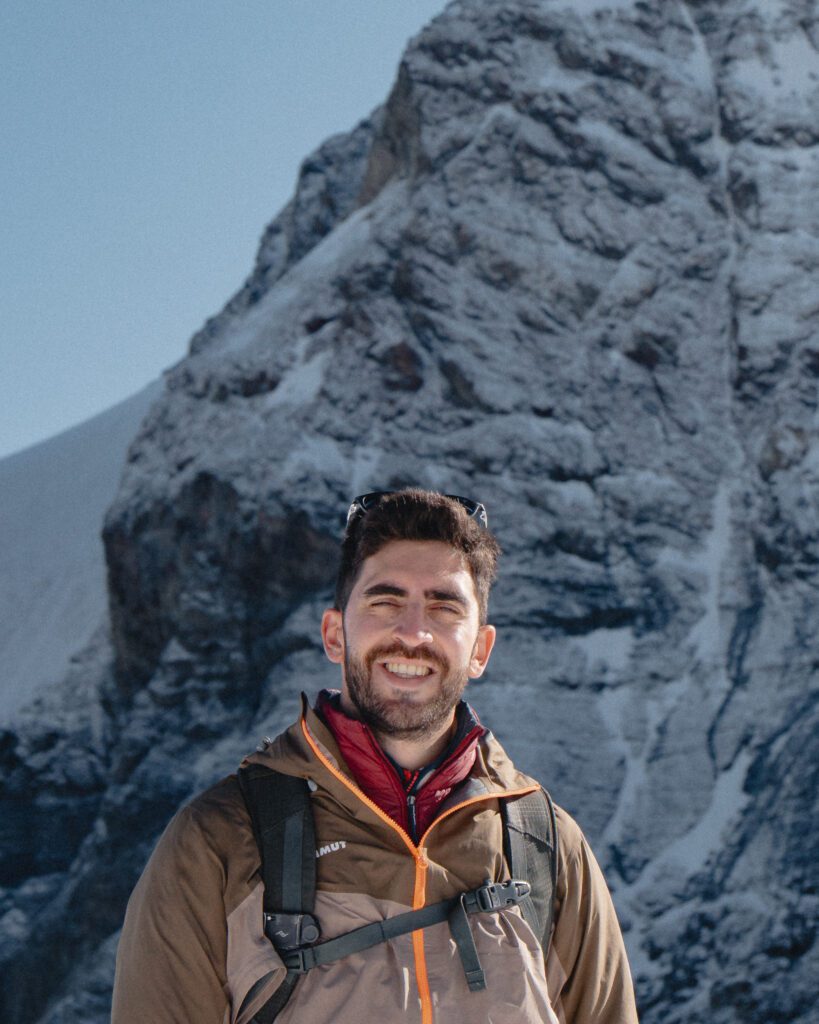
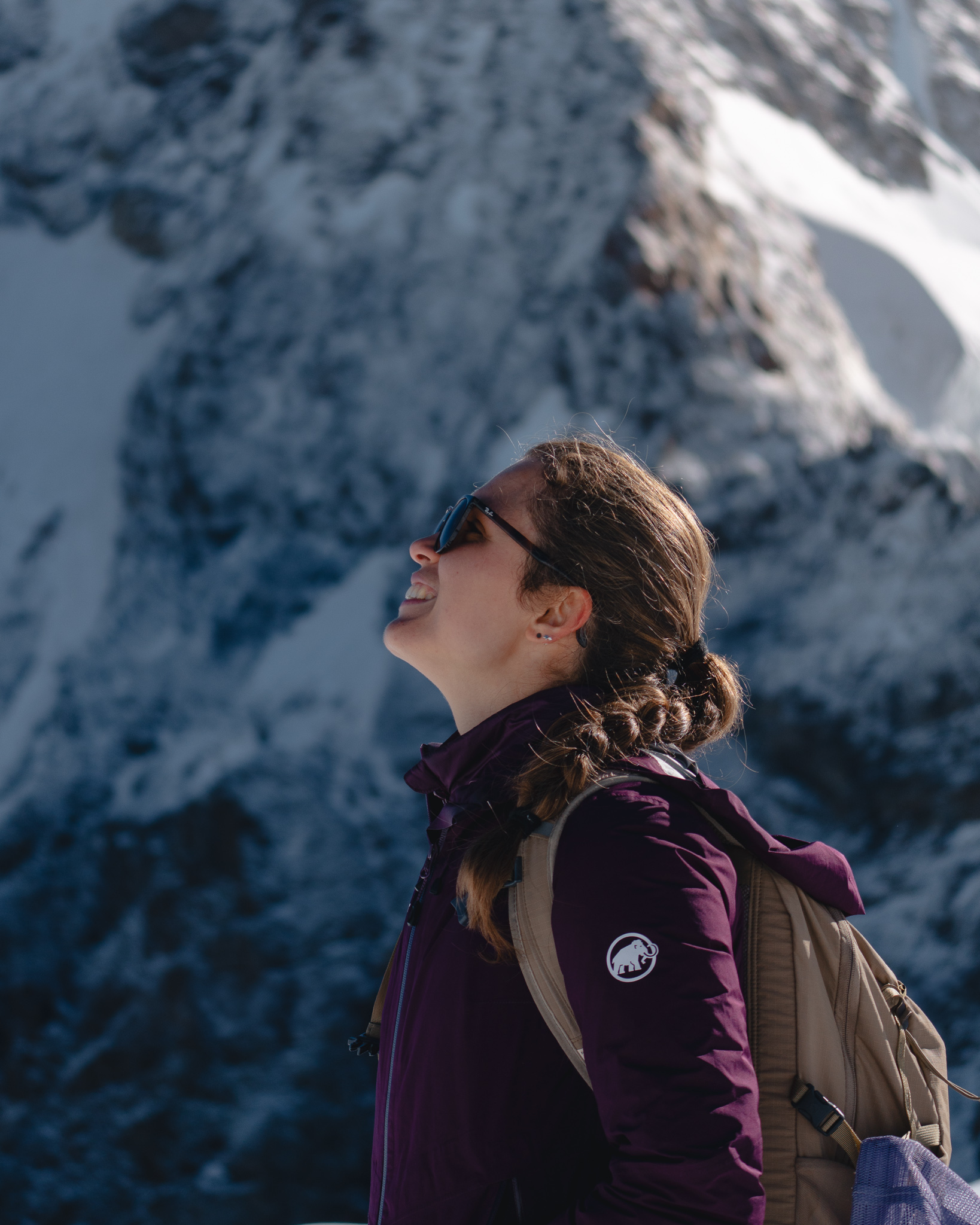
- Outer layer: a windproof and waterproof jacket, ideally compact and easy to pack away. In our opinion, this is the most important layer in these conditions. We use this Mammut jacket, but this Salewa alternative is a little more affordable.
- Comfortable, durable pants, ideally hiking or technical pants. Avoid denim or cotton if possible, as they can get wet easily in the snow and make the day much less enjoyable.
- Waterproof hiking boots: highly recommended, especially if you plan to walk on snow or hike to Mönchsjochhütte. We wore Lowa Renegade GTX and Salomon X Ultra 3 GTX.
- Sunglasses with strong UV protection and sunscreen. This is especially important because sunlight reflects intensely off the snow.
- A cap or lightweight sun hat.
- A small backpack with water, something to eat and an extra layer in case the weather changes.
In Winter
We haven’t visited Jungfraujoch in winter, but during the four years we lived in Switzerland we went up plenty of mountains at similar elevations, and conditions can become genuinely polar. In winter, protecting yourself properly from the cold becomes even more important.
- Heavy thermal base layer: high-quality merino wool or synthetic fabric. As in summer, brands we recommend include Kari Traa (women only), Smartwool and Icebreaker. The fabric is similar to summer layers, but look for a heavier weight: at least 175, and ideally around 200–250.
- Warm mid layer: a thick fleece or insulated/down jacket.
- Waterproof and wind-resistant outer layer, ideally with a hood.
- Thermal or softshell pants suitable for snow, such as these Salewa pants. Another option is a wind- and water-resistant pair of pants such as these Fjällräven pants we use.
- Waterproof hiking boots with good traction.
- Insulated gloves or mittens.
- A warm hat or headband, plus a neck gaiter or balaclava to protect your neck and face.
- Thick hiking socks, plus a second pair in your backpack in case the first pair gets wet. This might be the most practical tip in the whole post: snow can easily get inside your boots.
When Is the Best Time to Visit Jungfraujoch?
July and August are the busiest months at Jungfraujoch, as this is one of Switzerland’s most famous attractions and the peak of the European summer holiday season. If you’d like to avoid some of the crowds while still having a good chance of pleasant conditions, we’d consider June, September or even May.
You can also visit Jungfraujoch in winter. The landscape looks completely different, and conditions can be much harsher because of the cold, wind and snow. The glacier is still visible, although the snow cover can make its shapes and crevasses less obvious than at other times of year. It can be a spectacular experience, but you’ll need to be much better prepared for the cold and accept that some outdoor activities may be closed depending on conditions.
Overall, we would probably choose June or September if you can make either work with your trip. They often offer a good balance between relatively pleasant conditions and fewer visitors than July and August, although mountain weather is never guaranteed. May can also be a good option, but some seasonal activities may not yet be operating.
If you’re visiting in high season, we’d once again recommend taking the first train so you can make the most of the quieter early hours.
Is Jungfraujoch Worth Visiting?
Visiting Jungfraujoch is one of those experiences that many people put on their Switzerland bucket list. It is undoubtedly one of the country’s best-known attractions, and it’s easy to understand why: very few places make it this easy to travel above 3,400 meters and find yourself surrounded by some of the most impressive peaks in the Alps.
That said, the excursion is expensive. The train fares and accommodation prices in the region are enough to make many travelers think twice before booking. We had already lived in Switzerland for four years by the time we finally decided to go up. And knowing that it is such a touristy place, with potentially large crowds in high season, can take away a little of the excitement beforehand.
But we do think that if you’re only going to visit Switzerland once, Jungfraujoch is an experience worth seriously considering. We were really glad we finally decided to do it. The views are spectacular, and being surrounded by glaciers and peaks this high feels genuinely special. For us, if you organize the day well, look for the right discount, take one of the first trains and know what to expect so you can make the most of the visit, it is a highly recommended experience. The reward is huge. Normally, landscapes like this are accessible only to mountaineers with years of experience and specialized equipment.
If you love the mountains and being outdoors, even if you’re not an expert, we think you’ll love Jungfraujoch.
So, in short: yes, we think Jungfraujoch is worth it.
Jungfraujoch FAQ
¿Cuánto dura la visita al Jungfraujoch Top of Europe?
La visita a Jungfraujoch dura aproximadamente 2 o 3 horas. Si se incluye la caminata al refugio Mönchjoch, se debe sumar otras 2 horas al total.
¿Cómo se llega a Jungfraujoch?
Solo se puede subir a Jungfraujoch en tren, desde la estación Eigergletscher. Para llegar a esta estación se puede tomar otro tren desde Interlaken, Lauterbrunnen o Grindelwald. Otra opción es el teleférico Eiger Express, que conecta la estación Eigergletscher con Grindelwald Terminal, siendo esta opción la más rápida.
- Si quieres organizar la visita a Jungfraujoch por tu cuenta, puedes comprar el billete desde la página oficial Jungfraujoch – Top of Europe.
- Si prefieres un viaje guiado en español, os recomendamos esta Excursión a Jungfraujoch de Civitatis y Best of Switzerland.
¿Es obligatorio reservar asiento en el tren a Jungfraujoch?
Sí, a partir de 2025 es obligatorio pagar por la reserva de asiento en el tramo final del tren, entre las estaciones Eigergletscher y Jungfraujoch. Esto no significa que sea obligatorio viajar en el tren en el que tienes reservado el asiento, si tu visita ha durado más de lo que esperabas, puedes esperar a montar en el tren en la sección “sin reserva”. Te dejarán acceder una vez las personas con reserva para ese horario se hayan montado y queden huecos libres.
¿Es una buena opción visitar el Jungfraujoch con niños?
¡Claro que sí! Es una opción perfecta, la excursión está totalmente adaptada a todas las edades. Además, hay nieve durante todo el año así que será bastante divertido para los más pequeños. Para quemar energía, se puede visitar el Snow Fun Park o hacer la caminata al refugio Mönchjoch.
¿Te puedes bajar en las paradas intermedias antes de llegar a Jungfraujoch?
Sí, y de hecho es muy recomendable que lo hagáis para explorar todo lo que tiene que ofrecer el billete a Jungfraujoch. Nosotros os recomendamos explorar estas paradas una vez finalizada vuestra visita a Jungfraujoch, y en especial os recomendamos bajaros en Eigergletscher y hacer una pequeña ruta de senderismo hasta Kleine Scheidegg.
¿Se permite el acceso a mascotas en Jungfraujoch?
Sí, se permiten mascotas en Jungfraujoch. Para el último trayecto en tren, entre las estaciones Eigergletscher y Jungfraujoch, es necesario pagar un suplemento de 30 CHF.
¿Se necesita reservar con antelación los billetes a Jungfraujoch?
No, los billetes se pueden comprar en el mostrador el mismo día de la visita. Sin embargo, hay bastante cola y tiempo de espera, por lo que nosotros os recomendamos comprar las entradas online.
Además, os recomendamos comprar los billetes con sólo un día de antelación, una vez que sepáis que habrá buen tiempo y podréis disfrutar al máximo de la experiencia.
- Si quieres organizar la visita a Jungfraujoch por tu cuenta, puedes comprar el billete desde la página oficial Jungfraujoch – Top of Europe.
- Si prefieres un viaje guiado en español, os recomendamos esta Excursión a Jungfraujoch de Civitatis y Best of Switzerland.
We hope you have an amazing visit to Jungfraujoch.
See you on the road!
Some of the links on this page are affiliate links. This means that if you make a purchase through one of them, we may receive a small commission at no additional cost to you. We use this income to help keep Alive & Roaming running and continue creating useful travel content. Thank you for supporting us.